
Spraying Food Plots
A complete overview of sprayer types, boom setups, timing strategies, and the key components that make every application count.
Why Should You Use a Sprayer for Food Plots?
Spraying is one of the most efficient and reliable methods for distributing inputs across your food plots. Whether you're applying fertilizer, herbicide, fungicide, or an organic nutrient supplement, a sprayer delivers results that hand application simply cannot match.
Just as rainfall waters crops naturally and evenly, spray droplets are an extraordinarily effective way to distribute the products your plot needs. Spraying can become a core part of your annual plot management routine — helping suppress weeds you don't want while actively fostering the growth of the plants you do. With the right equipment and approach, every pass of the sprayer contributes to a healthier, more productive food plot.
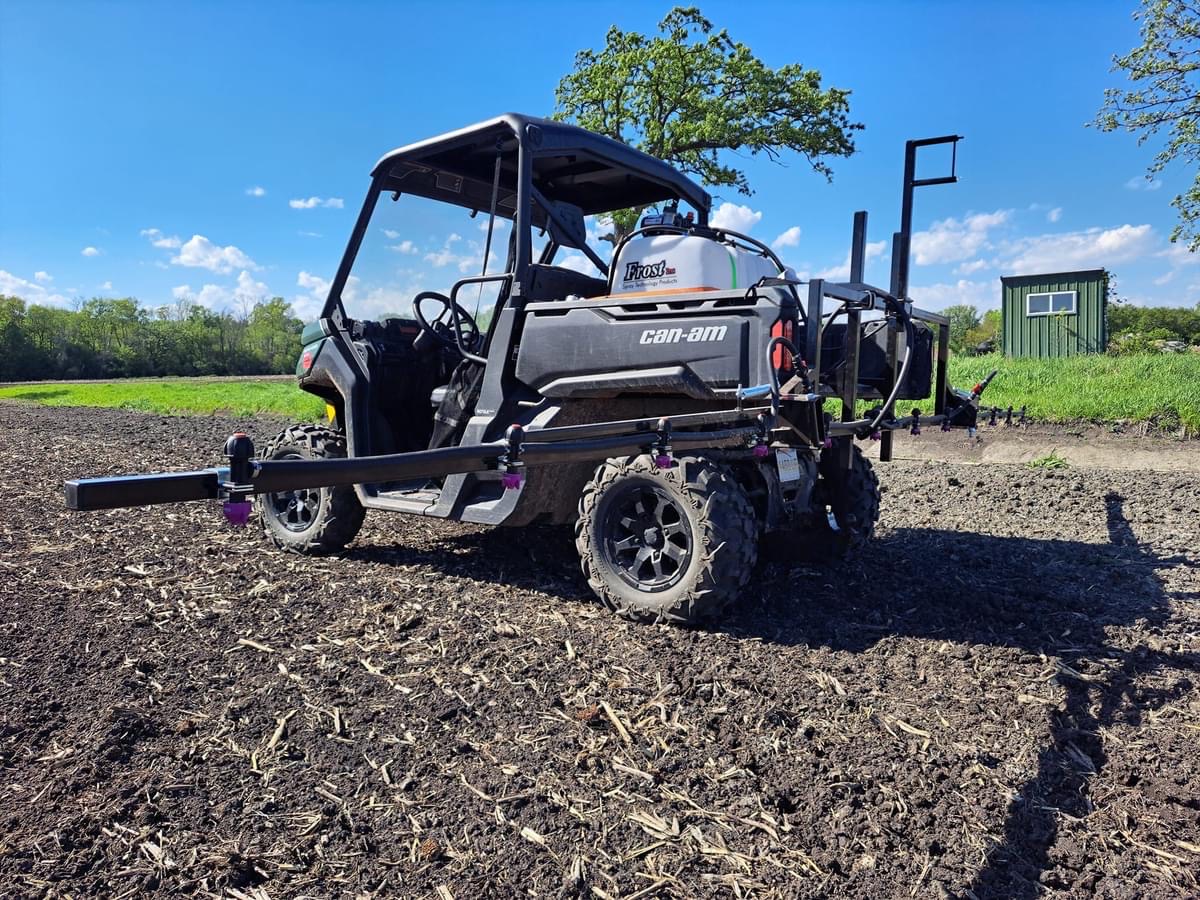
ATV-mounted sprayer featuring an 8-row boom — ideal for efficient food plot management in rough terrain.
Timing Is Critical
Before you ever pull a trigger on a spray wand, you need to understand the life cycle of the pest or weed you're targeting. Every plant and insect has a growth stage at which it is most vulnerable — and most responsive — to treatment. Spray too early or too late, and you've wasted product and time.
Know Before You Spray
- Thistles in pasture Spray before they flower and go to seed. Once seed heads form, you're spreading the problem rather than solving it.
- Japanese Beetles Do not spray when you see adult beetles on the plant. Products that kill adults can also harm beneficial pollinators like bees and butterflies. Instead, target the grub stage before they emerge.
- Systemic herbicides These work best when the plant is actively growing — typically during warm, sunny conditions when nutrient uptake is at its peak.
The single most effective thing you can do before purchasing any spray product is research the life cycle of the organism you're trying to control. Understanding when it is most susceptible turns an average spray program into a highly effective one.
Sprayer Types
The right sprayer for your food plot depends largely on the size of your operation, the terrain you're working in, and the equipment you already own. Here's a breakdown of the most common sprayer types used by hunters and landowners.
Manual & Backpack Sprayers
Perfect for getting started. Manual pump and backpack sprayers give you precision control in small, targeted areas. They're not practical for larger acreage but work well for spot treatments and tight spots where equipment can't reach.
ATV Sprayers
A popular choice in the hunting community. Simply mount the unit to your rack, attach the sprayer, and drive your path. ATVs handle rough ground well, making them well-suited for uneven food plot terrain.
UTV / Side-by-Side Sprayers
UTVs offer a larger bed space and greater carrying capacity than ATVs. They support bigger tanks and heavier spray setups, making them a smart upgrade when your plot grows beyond ATV range.
3-Point Hitch Sprayers
For landowners with a tractor, a 3-point hitch sprayer is a natural addition. It turns your tractor into a comprehensive spraying machine with tank capacities that make large acreage work fast and efficient.
Trailer Sprayers
Designed for larger properties, trailer sprayers can be towed by a variety of vehicles. They hold substantial tank volumes and are well-suited for commercial-scale or high-acreage food plot programs.
Skid Loader Sprayers
An increasingly popular option for landowners who already run skid loaders. Quick-attach designs make these systems fast to deploy and easy to integrate into an existing equipment lineup.
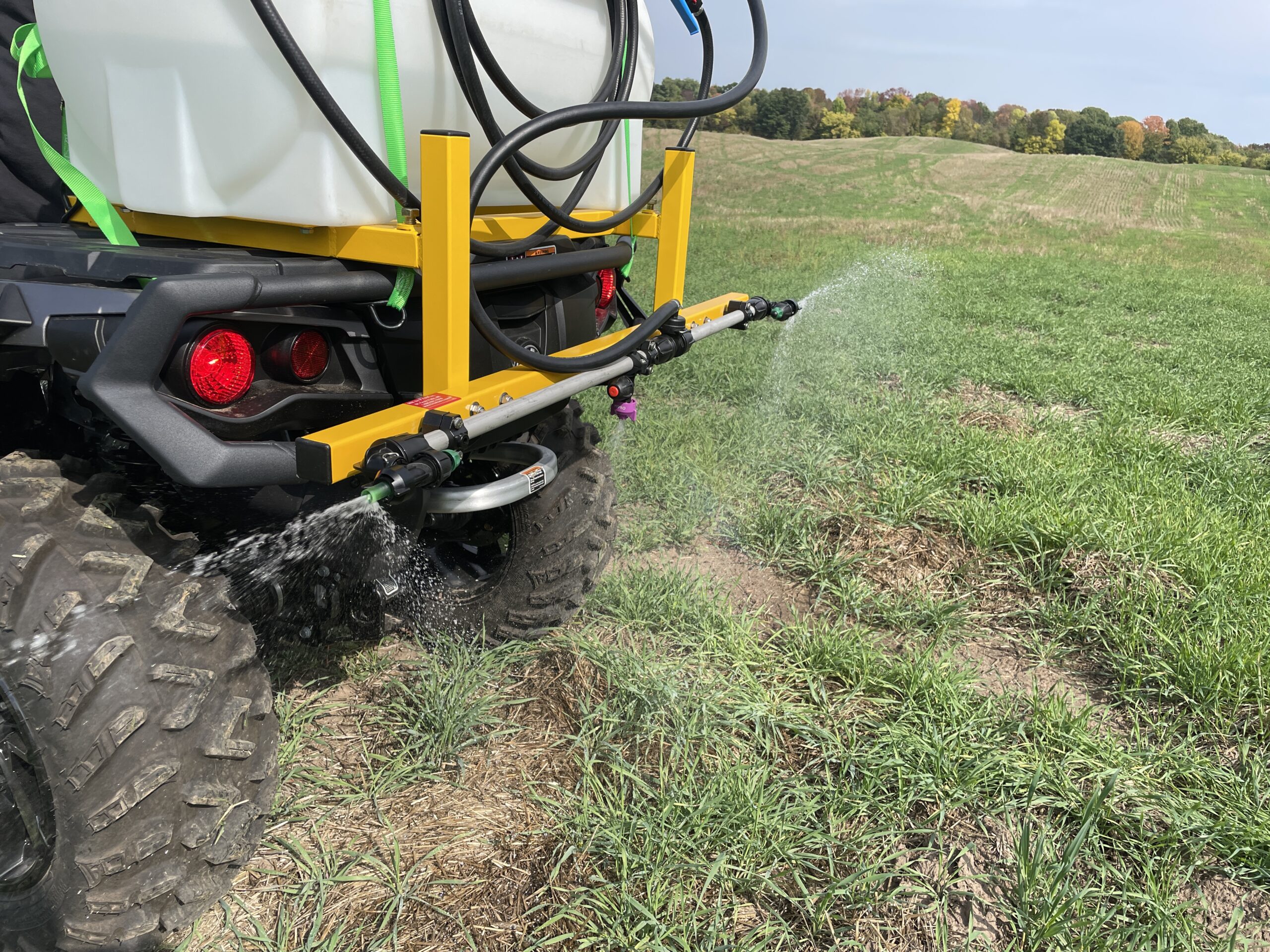
Close-up of boom nozzle setup — precision matters when it comes to coverage and spray uniformity.
Boom Types
Once you've selected your sprayer platform, the next decision is the boom setup. The boom you choose will directly determine how well your spray reaches its target — and how much drift ends up where it shouldn't.
Boomless Nozzle
A boomless nozzle mounts at the center of the sprayer and throws spray wide — up to 13 feet per nozzle, or 30 feet with dual ends. This design is invaluable when you're navigating rough ground, fence lines, or dense brush where a physical boom can't extend. Systemic herbicides that are absorbed through the entire plant are the best match for boomless nozzle systems.
Broadcast Boom
A broadcast boom uses a wide physical frame of fan nozzles that spray directly downward toward the ground, letting gravity carry the droplets to the target with minimal drift. Broadcast booms define a clean, precise spray edge — keeping product where you want it and away from areas you don't. Contact herbicides and fertilizers that work on impact are best suited for broadcast booms.
The right boom setup isn't just about coverage — it's about precision. Controlling where your product lands is just as important as the product itself.
Main Sprayer Components
Understanding what goes into a quality sprayer — and what to inspect before you head into the field — can mean the difference between a uniform application and a frustrating, ineffective pass. Here are the components that matter most.
Tank
Look for tanks made of heavy-duty roto-molded plastic rather than thin blow-molded material. Choose tanks with a sump at the bottom — this allows product to collect and drain fully, making it easy to empty completely between applications.
Shut-Off Valves
Always have a contingency plan. Any penetration into the tank should have a shut-off valve so that if something fails mechanically, the liquid product stays contained safely.
Agitation
Spray product that isn't kept in consistent suspension will settle to the bottom of the tank, especially when left sitting. Agitation or recirculation ensures a uniform mix and consistent application from start to finish.
Filter
Easily overlooked but critically important. Filters protect pumps, valves, and nozzles from sand and debris in spray tanks. Check your filter screens on a regular basis — a clogged screen will drop pressure at the nozzle and produce poor, uneven spray patterns.
Pressure Control Valves
Nozzles are calibrated to function within specific pressure ranges. Pressure control valves maintain the recommended operating pressure for your nozzles and ground speed, ensuring you're always applying the right amount of product.
Boom Section Valves
On larger broadcast booms, section valves let you control groups of nozzles independently — or even each nozzle individually — preventing overlap and eliminating wasted product on field edges or irregular plots.
Spray Nozzles
Nozzles are the last point of contact before the product reaches your target. They create the distribution pattern and are ultimately responsible for the overall efficacy of your sprayer. Never underestimate the importance of nozzle selection and condition.
Whether you're just getting into food plot management or upgrading an existing operation, the right sprayer setup makes every application more effective, more efficient, and more precise. Take the time to match your equipment to your acreage, your product to your target — and your timing to the life cycle of what you're treating. The results will speak for themselves.