
Managing room differential pressure is one of the most critical — yet frequently misunderstood — elements of modern facility design. Whether you are building a pharmaceutical cleanroom, a hospital isolation ward, or a specialized manufacturing space, the way air pressure is controlled between rooms determines everything from product purity to occupant safety.
The expectations for room differential pressures are outlined across a number of guidelines and standards. Regulatory agencies, including the FDA, require that pressure cascades be carefully designed and maintained. However, while the concept sounds straightforward — keep certain rooms at higher or lower pressure than their surroundings — the practical implementation involves a surprising number of engineering decisions, measurement challenges, and ongoing maintenance considerations.
In this article, we break down the core principles of room differential pressure control, explore HVAC design options that achieve it, and discuss best practices for monitoring and maintaining pressure relationships across your facility.
Why Differential Pressure Matters in Controlled Environments
At its core, differential pressure is the difference in air pressure between two adjacent spaces. In facilities that handle sensitive materials — whether pharmaceutical compounds, sterile medical products, or hazardous substances — this pressure difference serves as an invisible barrier. A room maintained at a higher pressure relative to the corridor outside it ensures that air flows outward when doors open, preventing unfiltered corridor air from entering the clean space and potentially contaminating the work within.
Conversely, rooms that contain hazardous agents or potent compounds are often kept at negative pressure relative to their surroundings. In these scenarios, the airflow direction is reversed — air moves into the room from the corridor — ensuring dangerous particles or fumes remain contained rather than migrating to adjacent spaces where they could endanger workers or compromise other processes.
Regulatory bodies such as the FDA, ISPE, and WHO all provide guidance on maintaining appropriate pressure cascades. Common target differentials range from 5 Pa (0.02 inches of water gauge) up to 15 Pa (0.06 in. w.g.) or more, depending on the application, room classification, and the criticality of the process involved.

HVAC System Design Approaches for Pressure Control
Achieving and sustaining room differential pressures is primarily the job of the HVAC system. There are several design approaches that engineers use, and each comes with its own set of advantages, limitations, and ideal use cases. The right choice depends on factors such as the facility's complexity, the number of pressure zones required, regulatory requirements, and budget constraints.
Fixed Offset System
One of the simplest methods involves setting a fixed airflow offset between supply and exhaust for each room. By delivering a predetermined volume of air more than what is exhausted, the room maintains a slight positive pressure. This approach is relatively inexpensive and easy to commission, but it lacks the ability to respond dynamically to changing conditions — such as doors opening or leaks in the building envelope. It is best suited for facilities with stable, predictable operating conditions and minimal disruptions.
Direct Pressure Control System
A more sophisticated approach uses real-time pressure feedback to modulate supply or exhaust airflow. Pressure sensors installed in the rooms continuously measure the differential and send signals to variable air volume (VAV) dampers or fans, which adjust flow rates on the fly. This system is far more responsive to disturbances and can handle the dynamic nature of real-world facilities — including door openings, personnel movement, and equipment cycling. The tradeoff is increased complexity, cost, and the need for careful calibration and ongoing maintenance of sensors and controls.
Tracking System
Tracking systems represent a hybrid approach. The supply airflow is controlled to maintain a fixed offset above the exhaust, but the exhaust volume itself is allowed to vary based on process demands. This means that as exhaust requirements change — perhaps due to fume hoods or equipment operations — the supply tracks along to maintain the pressure relationship. This method offers better flexibility than a pure fixed-offset approach without the full expense and complexity of a direct pressure feedback loop.
Cascade & Combination Approaches
In large or highly complex facilities, engineers often combine methods. A cascade arrangement layers multiple pressure zones with progressively higher or lower pressures as you move toward the most critical area. Combination systems may use fixed offsets in less critical zones while deploying active pressure feedback in the most sensitive rooms. These designs require careful coordination and commissioning but deliver the highest level of control across multi-zone facilities.
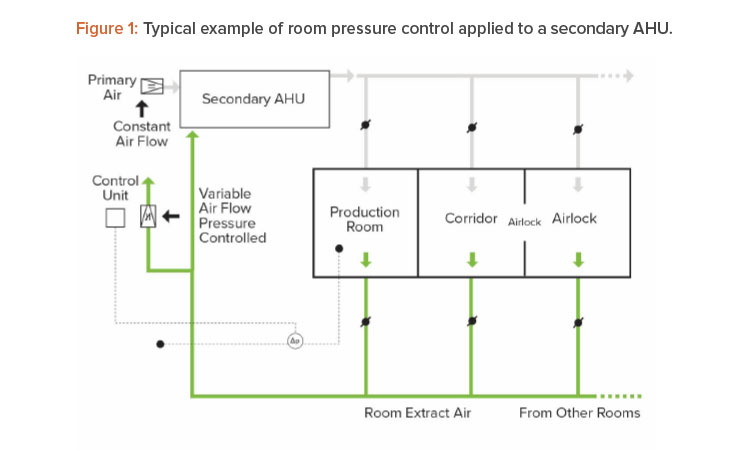
Air Handling Unit Control and Its Role in Pressure Management
The air handling unit (AHU) sits at the heart of any pressure control strategy. Proper AHU control goes beyond simply delivering conditioned air — it must coordinate supply and return fan speeds, manage filter loading effects, and respond to changing building loads while preserving the designed pressure relationships between rooms.
Modern AHUs often use variable frequency drives (VFDs) on both supply and return fans. By independently controlling fan speeds, the system can maintain a consistent offset between supply and exhaust volumes even as demand fluctuates. Some designs incorporate static pressure sensors in ductwork to modulate fan output, while others rely on volumetric flow measurements for a more granular level of control.
Regardless of the control strategy, regular filter replacement and ductwork inspections are essential. As filters load with particulates, airflow resistance increases, which can gradually shift the supply-exhaust balance and erode the differential pressure setpoint if the system is not properly compensated.
"Proper differential pressure monitoring is not a luxury — it is a fundamental requirement for any facility where air quality, contamination control, or occupant safety is at stake."
Measuring Pressure Differentials: Methods and Considerations
Accurate measurement is the backbone of effective differential pressure management. Without reliable readings, even the most well-designed HVAC system cannot guarantee that pressure relationships are being maintained. There are two primary measurement approaches used in practice.
Room-to-Room (Adjacent) Measurement
This method places a differential pressure sensor between two adjacent rooms, directly reading the pressure difference across the shared wall. It provides an immediate and highly relevant measurement of the relationship between the two spaces. However, in facilities with many rooms, this approach can require a large number of sensors and reference tubing runs, increasing cost and maintenance burden.
Common Reference Point Measurement
An alternative approach measures each room's pressure relative to a single, stable reference point — often an outdoor location or a large, relatively stable corridor. By comparing each room's reading to the same baseline, the pressure relationships between all rooms can be inferred mathematically. This simplifies installation in large facilities but introduces potential error if the reference pressure itself is not stable, as outdoor conditions can fluctuate with wind and weather.
In practice, many facilities use a combination of both approaches — direct measurements across the most critical boundaries and common-reference measurements elsewhere for a broader system overview.
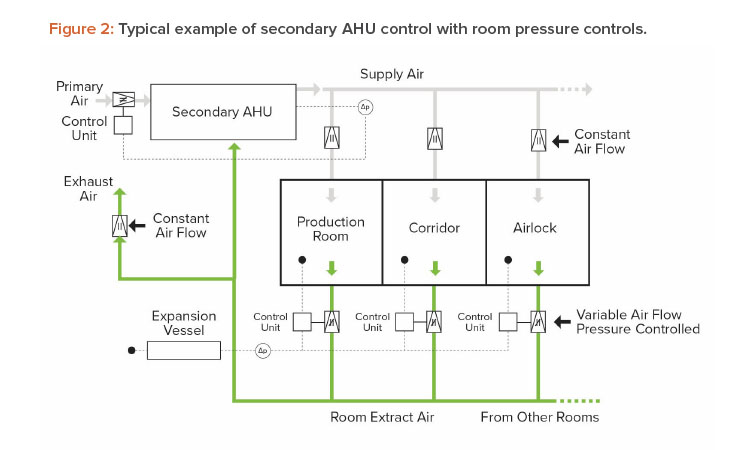
Selecting the Right Instruments for Pressure Monitoring
Not all pressure sensors are created equal. Room differential pressures are typically very small — often in the range of a few pascals or hundredths of an inch of water gauge — and the instruments used to measure them must be sensitive enough to detect these tiny differences reliably.
Capacitance-based sensors and thermal-based mass flow sensors are among the most common technologies used for low-range differential pressure measurement. When selecting instruments, engineers must consider factors such as measurement range, accuracy, long-term stability, response time, and susceptibility to environmental conditions like temperature and humidity fluctuations.
Equally important is the installation itself. Sensor placement, tubing length and routing, and the location of pressure taps on the wall all affect measurement quality. Poor installation can introduce errors that are difficult to diagnose later, so careful attention during commissioning is well worth the investment.
Signal Processing, Alarm Delays, and Practical Challenges
Raw pressure signals are inherently noisy. Door openings, personnel movement, and even HVAC cycling create momentary pressure fluctuations that do not represent a genuine loss of control. Effective monitoring systems incorporate signal processing — such as time averaging, filtering, or deadband logic — to smooth out these transient events and reduce nuisance alarms.
Alarm delays are another critical design element. It is common practice to introduce a time delay before an alarm is triggered, allowing the system to distinguish between a brief, inconsequential door opening and a sustained deviation that indicates a real problem. The appropriate delay depends on the criticality of the room — highly sensitive environments may require shorter delays, while less critical areas can tolerate longer ones without compromising safety.
Engineers must also consider what happens during a power failure. Many facilities require that pressure relationships be maintained — or at least fail to a safe state — during a loss of power. This may involve backup generators, uninterruptible power supplies for critical controls, or fail-safe damper positions that default to a configuration preserving the most essential pressure barriers.
Key Takeaways
Design Intentionally: Choose an HVAC pressure control strategy that matches the facility's complexity, regulatory requirements, and operational profile.
Measure Accurately: Invest in quality instruments, install them correctly, and validate readings during commissioning and regularly thereafter.
Monitor Continuously: Smart signal processing, appropriate alarm delays, and power failure planning keep your facility compliant and safe around the clock.
Door Control and Airlock Considerations
Doors represent one of the largest and most frequent disruptions to room differential pressure. Every time a door opens, the pressure barrier between two spaces is temporarily compromised. In critical environments, this disruption must be minimized and managed through careful design.
Airlocks — small buffer rooms between two pressure zones — are one of the most effective solutions. By requiring personnel to pass through an intermediate space, airlocks prevent a direct, open pathway between zones of different pressure. Interlocking door controls can further enhance this by ensuring that only one door is open at any given time, preserving the pressure cascade even during transitions.
Door closers, gaskets, and seals also play a supporting role by reducing the effective gap area when doors are closed, minimizing leakage and making it easier for the HVAC system to maintain the desired differential with less airflow offset.
Featured Product
Take Control of Your Room Pressure Monitoring
Reliable, real-time pressure monitoring is essential for maintaining compliant and safe differential pressure in any controlled environment. Equip your facility with professional-grade monitoring tools designed for the job.
Room Pressure Monitor – RPM-RT SeriesPower Failure Response and Fail-Safe Design
A facility's pressure control system is only as dependable as its performance during the worst-case scenario — a complete power loss. When electricity fails, fans stop, dampers can drift, and without a planned response, the carefully established pressure cascade collapses within seconds.
Fail-safe design requires anticipating this scenario from the start. Critical supply and exhaust fans should be connected to emergency power systems, whether through building generators or dedicated uninterruptible power supplies. Dampers in the most critical positions should have spring-return actuators that default to a safe position during a loss of control signal.
Beyond equipment, operational procedures should define how staff respond to alarms during power events — including when to evacuate certain areas, when to seal doors manually, and how to verify that pressure relationships have been restored once power returns.
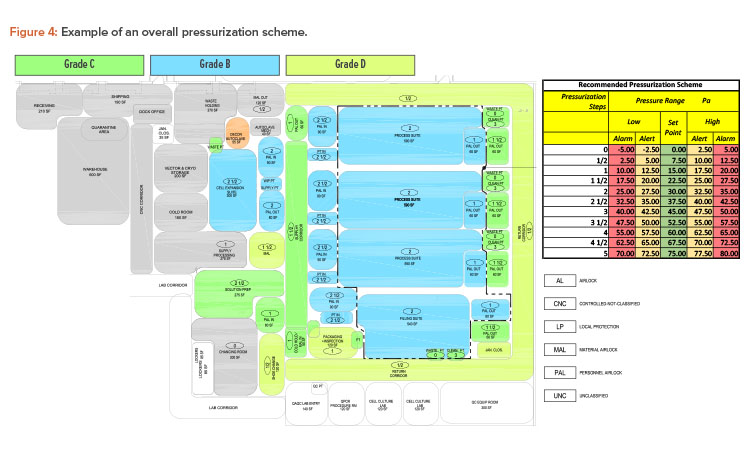
Conclusion
Room differential pressure management is a foundational pillar of controlled environment design. From selecting the right HVAC strategy and choosing appropriate sensors to implementing smart alarm logic and planning for power failures, every decision in the chain contributes to — or detracts from — the facility's ability to maintain safe, compliant, and effective pressure relationships.
The best facilities treat differential pressure not as a checkbox on a commissioning report but as a living system that requires ongoing attention, calibration, and refinement. As processes change, equipment ages, and regulations evolve, the pressure control strategy must adapt in turn.
By investing in proper design, quality instrumentation, and a culture of vigilant monitoring, facility managers and engineers can ensure that their pressure differentials remain a reliable invisible barrier — protecting products, processes, and people day in and day out.
Published by Backyard Provider — Your trusted source for facility equipment, HVAC systems, and outdoor living solutions.