

Why Room Pressure Monitoring Matters in Healthcare
When it comes to designing or managing a hospital, clinic, or any healthcare facility, controlling the indoor environment is not optional — it is a matter of patient and staff safety. Areas such as isolation rooms, surgical suites, pandemic readiness zones, and hospital pharmacies all demand meticulous airflow management to limit the spread of airborne pathogens.
Each of these critical spaces requires properly regulated airflow to protect everyone inside. Depending on the intended use, a room may need to maintain either higher or lower air pressure relative to adjacent corridors and spaces.
Positive vs. Negative Pressure — What's the Difference?
Positive pressure rooms (e.g., sterile operating rooms) push air outward, preventing contaminated air from entering.
Negative pressure rooms (e.g., isolation rooms) draw air inward, preventing airborne pathogens from escaping into hallways.
This difference in relative air pressure between two spaces is commonly referred to as differential air pressure. Modern room display systems capture both real-time and historical data, replacing outdated pressure indicators and significantly improving compliance readiness across the facility.

Achieving Regulatory Compliance with Room Pressure Monitoring
Many basic pressure indicators appear cost-effective at first glance and seem to satisfy minimum compliance standards. However, they often create significant operational headaches for building managers, safety officers, and facility administrators who need verifiable data on HVAC performance over time — along with a documented track record of pressure compliance throughout their buildings.
Regulatory organizations such as The Joint Commission have increasingly tightened their inspection criteria and now enforce room pressure regulations far more strictly than in years past. During an inspection walk-through, an inspector may confirm that certain rooms are currently in compliance, but because most traditional pressure devices are simple pass-or-fail indicators, they generate no historical records. That means there is no way to demonstrate overall organizational compliance or prove how past issues were identified and resolved.
Hospital facility managers often struggle with staffing shortages as well. Manually recording room pressure data demands that someone physically walk every floor and document visual readings — yet this time-consuming process still only captures a single snapshot in time. Real-world case studies from major hospital systems show that implementing automated monitoring dramatically reduces manual labor while boosting accuracy.
How to Reclaim Valuable Staff Time
Manual pressure monitoring is inherently labor-intensive, prone to human error, and pulls skilled personnel away from their core clinical and operational duties. As regulatory bodies push healthcare organizations toward higher patient safety standards, facility leaders nationwide need solutions that keep up.
Wireless room pressure sensing systems that deliver accurate, reliable, around-the-clock data logging are becoming indispensable tools in the fight against infectious disease. Installing automated monitoring effectively future-proofs a facility, removing the burden of recording and logging data from already stretched staff. By proactively meeting regulatory requirements, organizations save time and money — resources better directed toward patient care.
~$80,000
Typical annual labor savings per 100 hospital beds with automated monitoring
Understanding the ROI of Wireless Cloud-Based Monitoring
Today, a growing number of automated room pressure monitoring solutions provide hospitals with a significantly better return on investment compared to manual logging and reporting workflows. These modern systems eliminate tedious paperwork and deliver continuous, verifiable compliance data.
However, many of these automated platforms still require costly retrofitting of a hospital's existing Building Automation System (BAS). Integrating BAS-dependent devices can be time-consuming, expensive, and operationally disruptive — a real problem when facilities need to pivot quickly due to tightening regulations or the sudden need to establish new isolation rooms, as was seen during the COVID-19 pandemic.
The best wireless cloud-based monitoring solutions deliver immediate ROI when compared to both manual methods and legacy wired systems currently deployed in hospitals. To understand the potential savings for a specific facility, consulting with a monitoring specialist is a straightforward process that typically takes only a few minutes.
Because modern cloud platforms are purpose-built for healthcare environments, they natively support a wide variety of additional monitoring applications — from temperature tracking of freezers, refrigerators, and cryogenic storage to ambient room temperature and humidity monitoring. All of these capabilities are seamlessly unified in a single cloud-based dashboard, giving facilities total operational visibility.
How Does Wireless Cloud-Based Monitoring Work?
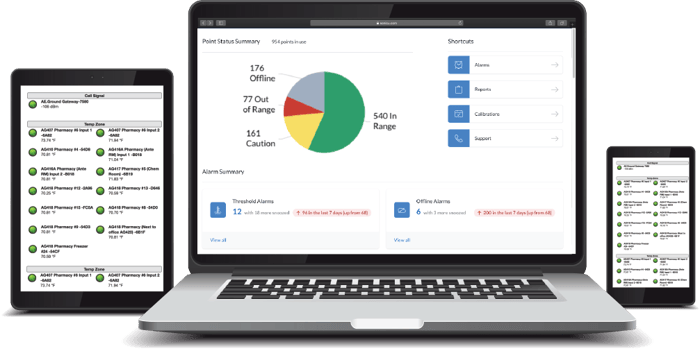
Wireless monitoring systems use digital sensors to transmit data over Wi-Fi, 4G/5G LTE, or Ethernet connections to a secure cloud-based software platform. These platforms are typically hosted on enterprise-grade infrastructure such as Amazon Web Services (AWS), ensuring maximum data security and reliability.
Facility personnel — from administrators and managers to frontline users — benefit from the ability to remotely view real-time pressure conditions for every monitored room through a centralized cloud dashboard. They can also pull up historical data instantly to generate compliance reports whenever needed.
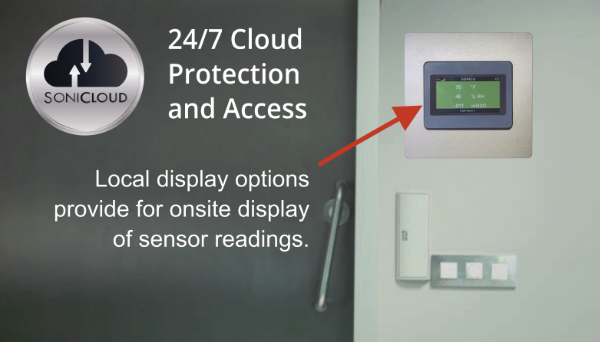
On-site, flush-mounted local displays provide actual room pressure readings at each monitored location, offering color-coded status indicators that are easy for staff to interpret at a glance.
Advanced cloud platforms include intelligent reporting suites that automatically aggregate all collected data and compile it into regulatory-compliant reports meeting the requirements of organizations like The Joint Commission, HFAB, BoP, and others. This eliminates hours of manual report preparation.
Built-in alarm handlers are highly configurable, ensuring that designated staff receive alerts via text, phone call, or email — or all three simultaneously — whenever room pressure drifts outside acceptable ranges for a defined period. This rapid notification system dramatically reduces response times.
These flexible monitoring platforms also support BAS integration when needed, accomplished via API connectivity rather than disruptive physical hardwiring into the existing building automation system.

What Does the Future of Cloud-Based Monitoring Look Like?
Over the past decade and a half, cloud-based wireless monitoring systems have rapidly gained traction and are quickly becoming the industry standard across a wide spectrum of monitoring applications. The shift is unmistakable and accelerating.
The reason is simple: these systems automate data logging and reporting around the clock, deliver stronger data security, provide better operational visibility with granular detail when needed, and offer the best overall ROI with the lowest total cost of ownership.
Wireless room pressure monitoring represents a future-proof investment for any healthcare facility seeking a cost-effective, easy-to-deploy, and highly accurate system that scales effortlessly as needs evolve. Facilities that embrace this technology today will be well-positioned to meet both current and emerging regulatory demands.
Featured Product
Abatement Technologies Room Pressure Monitor
Equip your facility with reliable, professional-grade room pressure monitoring. The RPM-RT Series delivers the accuracy and dependability your healthcare environment demands.
RPM-RT Series Monitor