
When it comes to achieving air that is both biologically and chemically clean, UV air purifiers stand as one of the most effective solutions available today. Originally gaining traction in North America for commercial HVAC applications, this technology has steadily expanded into residential and off-grid settings — offering reliable protection against airborne contaminants, odors, and microbial threats.
In the United States, UV air purification is already a specified requirement for air handling units installed in public sector buildings. It has even been evaluated by the US National Homeland Security Research Centre and found effective in safeguarding building occupants against bio-terrorism threats. With the technology now documented in the ASHRAE handbook, its credibility and relevance continue to grow worldwide.
Technical Fundamentals
The UV light spectrum includes a particular wavelength — 254nm — that has been proven exceptionally effective at neutralizing micro-organisms. This is the basis of ultraviolet germicidal irradiation (UVGI) technology. When UV light at this wavelength strikes bacteria, viruses, and spores, it penetrates the organism's cell wall and disrupts its DNA. This prevents cellular reproduction and ultimately leads to the organism's elimination within its naturally short life cycle.
A second important UV wavelength is 187nm, commonly referred to as UVV. This wavelength is employed for the photo-oxidation of airborne chemicals and persistent odors. UVV light generates ozone, oxygen singlets, and hydroxyl radicals (O3, O, and OH), which are highly effective at breaking down volatile organic compounds and other chemical pollutants. However, because UVV can leave residual ozone concentrations that may be harmful to occupants, it is always paired with and followed by a UVGI system. The UVGI unit acts as a catalyst, safely converting residual O3 back to O2 before the treated air reaches living spaces.
Key Takeaway
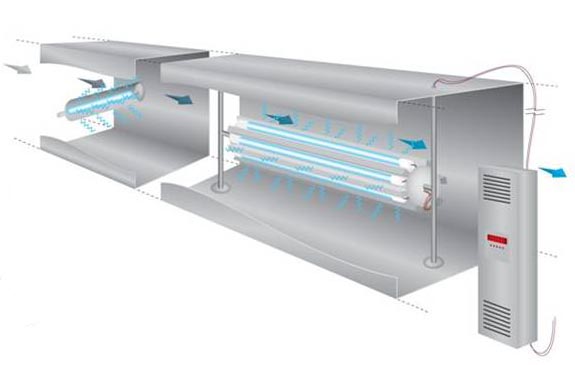
In ducted HVAC systems, UV purification typically comes in two forms: UVV for chemical and odor treatment, and UVGI for biological decontamination. When both types of challenges need to be addressed, UVV and UVGI lamps are used together in series to ensure complete and safe air purification.
Two UV air purifiers used in series — UVV and UVGI combined for biological and chemical treatment.
Coil Cleaning & Efficiency
One of the most practical applications of UV technology within HVAC systems is coil cleaning. UV lamps are strategically positioned to bathe the cooling coils and drain pan of an air handling unit in germicidal UVC light. This continuous exposure prevents the accumulation of mold, slime, and other biological growth that would otherwise thrive on the cool, moist surfaces of these components.
Without UV treatment, these biological deposits create significant problems. They block heat exchanger fins, degrade thermal efficiency, and become a persistent source of contamination that gets picked up by airflow and circulated throughout occupied rooms. UV coil cleaners eliminate this biomass entirely, preserving the original operating efficiency of the coils while removing the costs associated with manual cleaning, system downtime, and maintenance scheduling.
Biological Protection
UVGI systems neutralize bacteria, viruses, mold spores, and other micro-organisms by disrupting their DNA at the cellular level — preventing reproduction and ensuring elimination.
Chemical & Odor Removal
UVV technology breaks down volatile organic compounds, airborne chemicals, and persistent odors through photo-oxidation — producing reactive agents that decompose pollutants.
HVAC Efficiency
UV coil cleaning prevents mold and slime buildup on cooling coils and drain pans, maintaining peak thermal efficiency and eliminating costly manual maintenance downtime.
Proven & Trusted
Specified for US public sector buildings, endorsed in the ASHRAE handbook, and validated by homeland security research — UV air purification is an established and credible technology.
Why Consider UV Air Purification?
Whether you are outfitting a home HVAC system, a commercial facility, or an off-grid cabin, UV air purification offers a layer of defense that traditional filters simply cannot match. Standard filtration captures particulates, but UV technology goes further — actively destroying biological threats and breaking down chemical pollutants at the molecular level.
For homeowners particularly concerned about allergies, respiratory health, or maintaining a clean living environment, standalone UV air purifiers provide an accessible entry point. These units bring industrial-grade germicidal technology into a compact, residential form factor that can be placed in living rooms, bedrooms, or home offices — delivering hospital-quality air without the complexity of a full ducted system.
The combination of proven effectiveness, low ongoing maintenance, and energy efficiency makes UV air purification one of the smartest investments you can make in the health and comfort of your indoor environment.
Featured Product
Ready to Breathe Cleaner Air?
Explore the Airpura UV700 — a powerful UV air purifier designed to eliminate airborne micro-organisms, chemicals, and odors from your living space.
Airpura UV700 Air Purifier