
Selecting the ideal electric garden cart can transform the way you manage your yard. Rather than straining your back hauling soil, mulch, and heavy tools by hand, a powered cart does the heavy lifting for you. The key is knowing what to look for — battery performance, build quality, safety standards, and ergonomic design all play a critical role. This guide walks you through every factor so you can make an informed decision and invest in a cart that truly fits your outdoor lifestyle.
Key Takeaways
Match the cart to your yard size. Smaller yards work well with compact, lightweight carts. Larger properties demand higher load capacity and extended battery range.
Prioritize lithium-ion batteries. They outlast lead-acid options, recharge faster, and require virtually no maintenance — perfect for frequent use.
Look for essential safety features. Headlights, seat belts, reliable braking systems, and reflectors all help prevent accidents during use.
Consider comfort and ergonomics. Adjustable handles, stable wheels, and intuitive controls let you work longer without fatigue.
Evaluate frame material carefully. Steel frames offer the best strength and weather resistance. Aluminum is rust-free but lighter-duty, and plastic resists corrosion but may crack over time.
Assess Your Yard Needs

Yard Size
Begin by evaluating how much ground you need to cover. A compact yard may only call for a smaller, lighter cart with moderate load capacity. But if you have a sprawling property with wide lawns, garden beds, and storage areas spread far apart, you will need a more powerful cart that handles heavier loads over longer distances. The table below outlines how different cart types align with various yard sizes and requirements:
| Cart Type | Load Capacity | Terrain Adaptability | Features |
|---|---|---|---|
| Electric Wheelbarrow | N/A | All-terrain | Operates across many surfaces |
| Power Wheelbarrow | N/A | Backyard | Quick charge times |
| Electric Platform Cart | 350 lbs | N/A | 12-hour battery life |
| Motorized Dump Cart | 400 lbs | Smooth surfaces | Compact design with dump function |
Tip: For larger yards, select a cart with higher load capacity and longer battery life. This helps you complete tasks faster with less effort.
Terrain
Take a close look at your yard's terrain. If you deal with hills, slopes, or rough ground, you need a cart built to handle those challenges. Features like robust braking systems, powerful motors, and oversized wheels are essential. They keep you safe and make navigating uneven surfaces far easier.
| Feature | Description |
|---|---|
| Reliable Braking System | Electronic parking, wheel brakes, and ECO downhill assist for controlled stops |
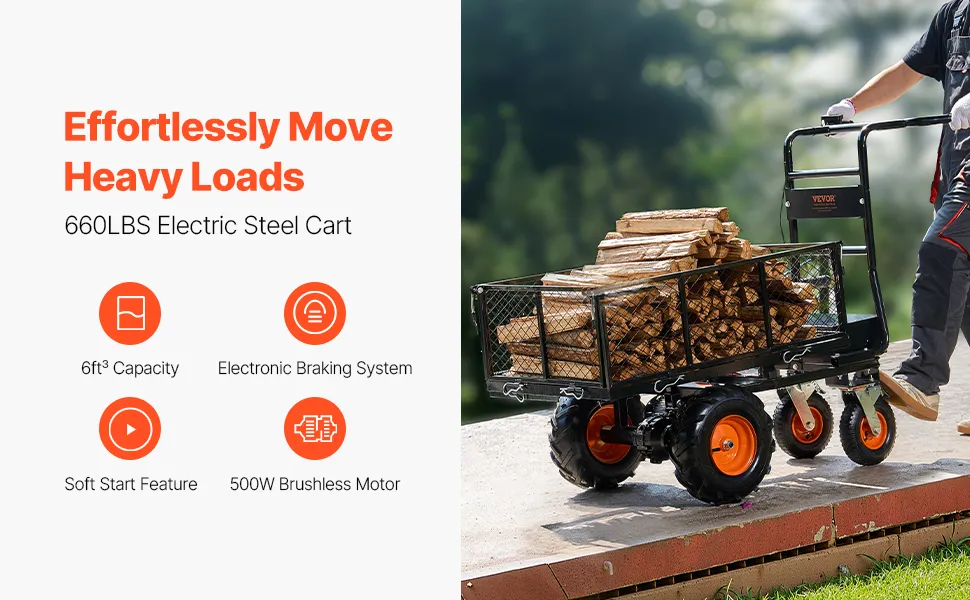
| Powerful Performance | A 36V, 500W motor handles slopes and heavy loads with ease |
| User-Friendly & Durable Design | 13-inch all-terrain wheels and rust-resistant materials for long-term outdoor use |
Typical Tasks
Consider the jobs you perform most frequently around your yard. Electric garden carts excel at moving heavy materials like dirt, mulch, and potted plants. They also simplify hauling garden tools and compost. Here are the most common applications where these carts truly shine:
Moving soil & mulch
Transporting plants
Hauling tools & gear
Carrying compost & waste
Electric carts dramatically reduce physical strain, allowing you to work longer without tiring out. Many models feature high load capacities and special functions like powered dump beds. Oversized wheels roll smoothly across grass, gravel, and packed earth, saving you both time and energy.
Note: Select a cart that aligns with your primary gardening tasks. This ensures you get the greatest value and efficiency from your purchase.
Electric Garden Cart Features
Battery Life
Battery life ranks among the most critical considerations when shopping for an electric garden cart. You want a power source that can sustain your longest work sessions without dying halfway through. The majority of modern carts rely on lithium-ion batteries, which deliver more power and significantly outlast older lead-acid alternatives.
Here is a side-by-side comparison of the two main battery types:
| Feature | Lead-Acid Batteries | Lithium-Ion Batteries |
|---|---|---|
| Lifespan | 2–6 years | Up to 10–15 years |
| Charging Time | 6–12 hours | 1–4 hours |
| Maintenance | High | Maintenance-free |
| Usable Capacity | ~50% | Up to 100% |
| Cold-Weather Performance | Struggles | Excels |
Lithium-ion batteries can endure 3,000 to 6,000 charge cycles, while lead-acid batteries typically manage only 500 to 1,200. That means far fewer replacements over the life of the cart. They also recharge in a fraction of the time and need virtually zero upkeep. In the long run, lithium-ion technology saves you money because the cost per use is significantly lower.
Tip: Go with a lithium-ion battery if you want longer service life, rapid charging, and hassle-free maintenance.
Safety Features
Safety should always be a top priority with any electric garden cart. Many models come equipped with specialized features designed to keep you protected and prevent mishaps on the job.
| Safety Feature | Description |
|---|---|
| Headlights, Taillights & Turn Signals | Help others see you and signal your direction |
| Seat Belts | Keep you secured if the cart stops abruptly |
| Rearview & Side Mirrors | Improve visibility and help avoid obstacles |
| Horn or Warning Signal | Alerts nearby people to your presence |
| Speed Governor | Limits top speed for safer operation |
| Windshields & Wipers | Shield you from dirt and rain while working |
| Parking Brake | Prevents the cart from rolling on slopes |
| Reflectors & Brake Lights | Increase your visibility, especially in low light |
| DOT-Approved Tires | Provide better grip across different surfaces |
| Safety-Certified Roof & Frame | Offers rollover protection in the event of a tip |
Certain electric garden carts also comply with recognized safety standards. For instance, the UL 62841-4-1000 standard evaluates stability, braking, and structural integrity. The CSA Group conducts similar testing. When you choose a cart that meets these certifications, you can trust that it has passed rigorous safety checks.
Comfort and Ergonomics
Comfort matters a great deal when you spend extended hours in the yard. A well-designed electric garden cart should feel effortless to operate even after a full day of work. Handle design plays an important role — adjustable handles let you set the height that prevents back strain. Wheel placement also influences comfort. Stable, well-positioned wheels make the cart easier to push and steer, so fatigue sets in much more slowly.
Adjustable handles let you find the ideal working position for your height.
Stable wheels keep the cart steady on uneven and bumpy terrain.
Note: Seek out carts with ergonomic handles and well-placed wheels to make every gardening session more comfortable.
Durability and Materials
You want your electric garden cart to stand up to years of outdoor use. The frame and body materials make all the difference. Steel frames deliver outstanding strength and bear heavy loads with ease. They also resist weathering well, which matters if your cart lives outdoors. Aluminum frames are long-lasting and rust-proof, but they may bend under extreme weight. Plastic or fiberglass frames resist corrosion and weigh very little, though they can crack or fade with extended sun exposure.
| Frame Material | Lifespan (Years) | Maintenance Notes |
|---|---|---|
| Steel | 10 to 20+ | Requires rust and corrosion protection |
| Aluminum | 15+ | Rust-free but may bend under heavy loads |
| Plastic / Fiberglass | 10 to 15 | Lightweight and rustproof; may crack or fade |
Steel frames offer superior stability, which helps prevent tipping. Steel also holds up well against rain and prolonged sun exposure, making it the top choice for outdoor equipment that sees regular use.
Storage Options
Smart storage solutions help you keep your electric garden cart safe and ready for action. If you have limited space, look for carts with foldable or stackable designs. Other storage considerations include:
Weatherproof covers: Protect your cart from rain, UV rays, and dirt buildup.
Carports and canopies: Offer overhead shelter from the elements.
Ventilation: Promotes airflow to prevent mold and mildew.
Security features: Locks or alarms deter theft.
Weather-resistant materials: Ensure your storage area can withstand extreme conditions.
Tip: If you have a small garage or shed, a foldable cart or a weatherproof cover can save space while keeping your cart in excellent condition.
Choosing the Best Garden Carts

Load and Payload Capacity
When choosing the best garden cart for your property, payload capacity should be at the top of your checklist. Some electric garden carts can haul impressive loads — certain models carry up to 750 pounds with a 6 cubic foot hopper. Others feature a maximum hauling capacity of 1,000 pounds with a 500-pound payload. Think carefully about what materials you move most often. Soil, mulch, and rocks each have different weights, so if heavy hauling is routine, opt for a higher-capacity cart.
Evaluate the weight of materials you transport most frequently.
Pick a cart with enough payload for your biggest jobs.
Choose a sturdy frame and corrosion-resistant finish for maximum lifespan.
Tip: If you use your cart for a wide range of tasks, select a model with a flat bed and adjustable cargo space. This gives you more flexibility for different loads.
Maneuverability
You need a cart that navigates your yard with ease. Maneuverability is especially important when you have tight spaces or complex layouts. Some electric garden carts feature a transaxle — a single unit that combines the transmission, axle, and differential. This design distributes power to both wheels evenly, allowing sharp turns, easy reversing, and smooth navigation through narrow garden paths. It makes handling the cart effortless, even in compact yards with many obstacles.
Seek out carts with a tight turning radius.
Check for large wheels and quality suspension.
Confirm the cart glides smoothly over grass, gravel, and uneven ground.
Note: If your yard is full of tight corners or narrow pathways, choose a cart with enhanced maneuverability. You will save significant time and effort.
Value and Warranty
Getting strong value for your money matters. Electric garden cart prices vary widely — premium models can run between $2,895 and $2,995, while budget-friendly options start around $329. When comparing prices, always factor in the warranty. A longer warranty provides better protection for your investment.
| Product | Price Range |
|---|---|
| Electric Garden Cart (Premium) | $2,895.00 – $2,995.00 |
| Electric Garden Wagon (Premium) | $2,895.00 – $2,995.00 |
| Utility Gardener Cart | $329.00 |
Some carts include a 5-year warranty.
Others may not specify warranty details.
Always verify the warranty before making your purchase.
Tip: A cart with a powder-coated steel frame resists corrosion and endures longer, adding real value over time.
Comparing Different Types of Garden Cart
Different garden cart models suit different yard situations. Some are built for heavy-duty hauling, while others handle lighter chores. The table below highlights the key distinctions:
| Feature | Budget Model | Top-Rated Model |
|---|---|---|
| Load Capacity | 573 lbs | 220 lbs |
| Battery Runtime | 2–5 hours | 3 hours |
| Construction Material | Steel frame, rust-resistant coating | Rust-resistant poly tray |
| Intended Use | Heavy-duty tasks | Light to medium tasks |
| Price | ~$409.90 | ~$499 |
| Customer Ratings | 4.3/5 stars (150+ reviews) | 4.2/5 stars (200+ reviews) |
For heavy loads and tough jobs, go with a steel-framed model that offers higher capacity. For lighter chores, a smaller cart with a poly tray may be all you need.
Why Choose Quality Brands for Reliability and Support

Trusted brands stand out for reliability and customer support. Top-tier carts offer hauling capacities up to 1,000 pounds with a 500-pound payload. The cargo area can hold six cubic feet of material, and many convert to a flat bed for oversized items. Powder-coated steel frames resist corrosion and last years longer than untreated alternatives. Customers consistently praise these carts for their durability and low-maintenance operation.
Quality carts feature strong frames and flexible cargo space.
They handle a wide variety of yard tasks with ease.
Powder coating protects the cart from rust and weather damage over time.
Step-by-Step Checklist for Matching Carts to Your Needs
Use this practical checklist to narrow down the best garden cart for your yard:
| Checklist Item | Description |
|---|---|
| Payload Capacity | Verify the weight and volume of materials you need to transport. |
| Durability | Choose sturdy materials for longer outdoor lifespan. |
| Power Source | Decide between electric and gas-powered options. |
| Maneuverability | Ensure the cart turns easily in tight spaces. |
| Customization Options | Look for adjustable beds and racks for different jobs. |
| Braking System | Confirm the cart has a safe and reliable brake. |
| Terrain Compatibility | Make sure the cart works on all surfaces in your yard. |
| Noise Level | Consider quieter carts for noise-sensitive neighborhoods. |
| Ease of Maintenance | Pick a cart that is simple to clean and repair. |
| Safety Features | Look for headlights and reflective markings for better visibility. |
✅ Review every item on this checklist before buying. It helps you zero in on the best garden cart for your unique yard and workload.
Choosing the right electric garden cart makes every yard task easier and more efficient. It is better for the environment and saves energy compared to gas alternatives. You can rely on it for a wide range of jobs — from hauling soil to transporting tools. It reduces physical strain and keeps your property tidy. Always evaluate battery life, safety, comfort, and durability before deciding. Use the checklist above to find a cart that truly fits your needs. Reputable brands deliver long-lasting performance and dependable support. Take time to think about your yard's layout and what you need to accomplish before you buy.
FAQ
How long does the battery last on an electric garden cart?
Most electric garden carts operate for 2 to 12 hours on a single charge. The exact runtime varies depending on the model, load weight, and terrain. Always check the product specifications for precise battery performance data.
Tip: Charge your cart after every use to maintain optimal battery health.
Can I use an electric garden cart on hills or uneven ground?
Yes, many electric garden carts perform well on slopes and rough terrain. Look for models equipped with strong motors, large wheels, and reliable braking systems. These features ensure safe, smooth movement across different surfaces.
| Feature | Benefit |
|---|---|
| Large Wheels | Better traction |
| Strong Motor | Handles slopes |
| Good Brakes | Safer stops |
What is the maximum weight I can carry?
Electric garden carts typically handle between 200 and 1,000 pounds. The exact limit depends entirely on the model. Always verify the payload rating before loading your cart. Exceeding the capacity can cause damage and shorten battery life.
How do I store my electric garden cart?
Keep your cart in a dry, covered area. A weatherproof cover provides extra protection from rain and sun. Clean the cart thoroughly before storage and lock the wheels if possible to prevent any movement.
Note: Proper storage significantly extends the working life of your cart.
Are electric garden carts easy to maintain?
Electric garden carts are generally very low maintenance. Wipe down the frame and wheels after each use. Inspect the battery and tires regularly. Follow the manufacturer's care instructions. Most electric models require far less upkeep than their gas-powered counterparts.