
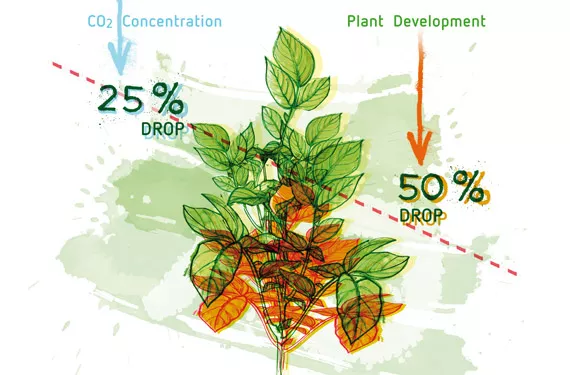
Carbon dioxide stands as a fundamental building block in the miraculous process of photosynthesis. The majority of indoor cultivation spaces maintain an ambient CO2 concentration hovering around 400 parts per million (ppm), which occurs naturally in our atmosphere. While plants can certainly survive at these levels, they possess the remarkable ability to utilize significantly higher concentrations to fuel enhanced growth and development.
When CO2 levels climb to approximately 1,000-1,500 ppm, plants transform this additional carbon into accelerated biomass production, resulting in faster vegetative growth, stronger stems, and ultimately more abundant harvests. For serious indoor gardeners seeking to maximize their cultivation potential, understanding and implementing CO2 enrichment can deliver remarkable improvements in overall plant health and productivity.
💡 Key Insight
Elevating CO2 concentrations to optimal levels can boost photosynthetic rates by 30-50%, translating directly into faster growth cycles and increased yields. However, proper implementation requires careful attention to environmental factors and safety considerations.
The Science Behind CO2 and Plant Growth
Photosynthesis represents the engine that drives all plant life, converting light energy, water, and carbon dioxide into the sugars that fuel growth. Under standard atmospheric conditions, CO2 often becomes the limiting factor in this equation. When you provide supplemental CO2, you effectively remove this bottleneck, allowing your plants to fully capitalize on available light and nutrients.
The relationship between CO2 concentration and photosynthetic rate follows a predictable curve. As CO2 levels rise from ambient 400 ppm toward 1,000-1,500 ppm, plants respond with proportionally increased carbon fixation. Beyond this threshold, diminishing returns set in, making concentrations above 1,500 ppm generally impractical and potentially harmful to both plants and humans.
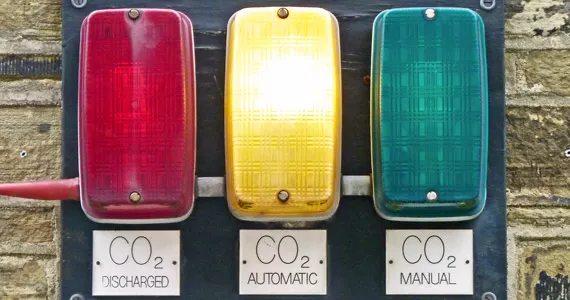
CO2 Considerations for Ventilated Growing Spaces
Introducing supplemental CO2 into spaces with active ventilation presents unique challenges that require thoughtful planning. In rooms where air constantly exchanges with the outdoors, maintaining elevated CO2 levels becomes an exercise in balancing input against loss.
For cultivation areas that rely on ventilation for temperature control, the constant air exchange will inevitably draw CO2 levels back toward ambient conditions. While adding CO2 to such spaces can still provide marginal benefits, the efficiency drops considerably compared to sealed environments. The continuous replenishment required often makes this approach economically impractical for most growers.
Important: In ventilated grow rooms, focus first on optimizing other growth factors such as lighting, nutrients, and temperature. CO2 supplementation yields the greatest returns when implemented in properly sealed environments where concentrations can be maintained consistently.
Optimizing CO2 in Sealed Growing Environments
Sealed grow rooms represent the ideal setting for CO2 enrichment programs. Without the constant air exchange that ventilated systems require, maintaining target CO2 concentrations becomes far more manageable and economical. In these controlled environments, supplemental CO2 can work its full magic on your plants.
Sealed room cultivation does demand additional environmental controls. Air conditioning replaces ventilation for temperature management, while dehumidification systems handle moisture removal. These investments pay dividends through precise environmental control and dramatically improved CO2 efficiency, allowing growers to maintain ideal conditions throughout the entire growth cycle.

Methods for CO2 Enrichment
Several approaches exist for delivering supplemental CO2 to your indoor garden, each with distinct advantages and considerations. Understanding these options helps you select the method best suited to your specific growing situation and budget.
CO2 Burner Generators
These units combust natural gas or propane to produce CO2. They offer economical operation for larger grow spaces and provide consistent output. The combustion process also generates heat and moisture, which must be factored into environmental planning.
Compressed CO2 Tanks
Bottled CO2 delivers pure gas without heat or moisture byproducts. This precision makes it ideal for smaller spaces or climate-sensitive applications. While the gas itself costs more than generator fuel, the clean delivery and accurate dosing appeal to many cultivators.
Fermentation Methods
Natural fermentation processes release CO2 as yeast metabolizes sugars. While this approach appeals to hobbyists seeking low-cost solutions, the unpredictable output and limited volume make it impractical for serious cultivation operations.
Environmental Factors for Successful CO2 Enrichment
Maximizing the benefits of supplemental CO2 requires attention to the complete growing environment. Plants can only capitalize on elevated CO2 when other growth factors align properly. Consider these critical elements when implementing your CO2 program:
Temperature Management
Elevated CO2 levels allow plants to thrive at slightly higher temperatures, with optimal ranges shifting from 75-80°F to 80-85°F. This increased heat tolerance can actually simplify climate control in sealed environments.
Light Intensity Requirements
CO2 enrichment only delivers results when paired with adequate lighting. Plants need sufficient light energy to power the enhanced photosynthesis that elevated CO2 enables. Without strong lighting, additional CO2 provides minimal benefit.
Humidity Considerations
Maintaining appropriate humidity levels becomes even more critical with CO2 supplementation. Sealed environments tend to accumulate moisture from plant transpiration, requiring active dehumidification to prevent mold and mildew issues.
Nutrient Availability
Faster-growing plants demand increased nutrition. When CO2 accelerates growth, nutrient uptake increases proportionally. Adjust feeding schedules and concentrations to match the enhanced metabolic rate your plants will achieve.
Does CO2 Enrichment Really Benefit Your Plants?
The short answer is a resounding yes—when implemented correctly. Plants grown with proper CO2 supplementation consistently demonstrate accelerated growth rates, increased resistance to environmental stress, and enhanced final yields. These improvements stem from the fundamental biology of photosynthesis operating at elevated efficiency.
However, success requires more than simply adding CO2 to your grow space. The complete environmental picture must support enhanced photosynthesis for plants to capitalize on the additional carbon. Lighting, temperature, humidity, and nutrition all play interconnected roles in determining whether your CO2 investment pays dividends.

Ready to Supercharge Your Indoor Garden?
Take your cultivation to the next level with professional-grade CO2 generation equipment designed for serious growers.
Autopilot CO2 GeneratorFinal Thoughts
CO2 enrichment represents one of the most powerful tools available to indoor cultivators seeking to maximize plant performance. When properly implemented within a well-designed growing environment, supplemental CO2 can dramatically accelerate growth rates and boost final yields beyond what atmospheric conditions alone can achieve.
Success with CO2 requires understanding the interconnected nature of plant growth factors and ensuring that lighting, temperature, humidity, and nutrition all support enhanced photosynthetic activity. For growers ready to make this investment in their indoor gardens, the rewards can be substantial and lasting.