

Understanding 1000W Power Stations
A 1000W portable power station occupies the ideal middle ground between compact size, reasonable cost, and functional output. It can charge your devices, power small tools, and keep household essentials running when the grid goes down. These units are quiet, lightweight, and simple to operate — no fuel, no fumes, and no complicated setup.
Before purchasing one, it helps to understand three core concepts that determine how the unit performs in the real world:
Continuous Power (Rated at 1000W): This is the maximum amount of power the station can sustain over a prolonged period without overheating or shutting down. If your appliance draws 800W, the unit handles it comfortably with headroom to spare.
Battery Capacity (Wh): Measured in watt-hours, this determines how long the station can deliver power. A 1000Wh battery powering a 100W device lasts roughly 10 hours in theory — closer to 8–8.5 hours when accounting for inverter efficiency losses of about 15–20%.
Surge Power (Peak): Many appliances like mini-fridges and small pumps demand a brief burst of power to start up — often 1.5× to 2× their running wattage. The surge rating tells you how much the station can handle for those few seconds.
Wattage vs. Watt-Hours: Know the Difference
Wattage (W) describes how much power the station can deliver at any given moment — think of it as the speed at which energy flows. Watt-hours (Wh), on the other hand, represent how much total energy the battery stores — this is your fuel tank.
A station rated at 1000W with a 1000Wh battery can power a 1000W appliance for about one hour, or a 100W device for roughly ten hours. Both specifications matter equally. A high wattage rating without sufficient capacity means your devices run but not for very long. Large capacity with low output means extended runtimes but limited ability to power demanding equipment.

Why Surge Power Matters
Numerous household appliances, particularly those with compressors or motors such as refrigerators, washing machines, and certain power tools, require a significant spike of energy to start up. This initial burst, known as surge or peak power, can be anywhere from 1.5× to 3× the appliance's standard running wattage.
If your power station's surge capacity cannot meet this startup demand, the unit will either fail to power the device or trigger its built-in overload protection. Always verify the surge wattage of your appliances (usually printed on the label or in the user manual) and compare it against the station's peak output before connecting.
Quick Comparison: Where 1000W Fits In
The table below shows how a 1000W unit compares with smaller and larger alternatives, helping you decide whether it matches your power needs:
| Feature | 500W Station | 1000W Station | 2000W+ Station |
|---|---|---|---|
| Typical Weight | 10–15 lbs | 20–30 lbs | 45–80 lbs |
| Best For | Phones, laptops, lights | Small appliances, tools, camping | Heavy loads, whole-home backup |
| Portability | Highly portable | Very portable | Less portable |
| Price Range | $200–$500 | $500–$1,200 | $1,200–$3,500+ |
| Can It Run a Fridge? | Small 12V models only | Mini-fridges (with caveats) | Full-size fridges |
What Can a 1000W Portable Power Station Actually Run?
A 1000W station can handle a wide array of low-to-medium power devices. Below is a detailed breakdown of compatible appliances along with their approximate wattage and estimated runtimes assuming a 1000Wh battery capacity:
| Device / Appliance | Watts (Approx.) | Est. Runtime |
|---|---|---|
| Smartphone Charger | 10–15W | 65–80+ hours |
| Laptop | 50–70W | 12–16 hours |
| LED Lights (string or bulb) | 10–25W | 35–80+ hours |
| Wi-Fi Router | 10–20W | 40–80+ hours |
| CPAP Machine | 30–60W | 14–28 hours |
| Portable Fan | 30–60W | 14–28 hours |
| Small TV (32") | 50–80W | 10–16 hours |
| Mini Fridge | 80–120W | 7–10 hours |
| Blender | 300–700W | Short bursts only |
| Coffee Maker | 600–900W | 1–1.5 hours |
| Drone Charger | 60–100W | 8–14 hours |
| Electric Grill (small) | 800–1000W | ~1 hour (at max) |
Note: Actual runtimes vary based on battery capacity, inverter efficiency (typically ~85%), and environmental conditions. Figures above assume a 1000Wh battery.
Advantages and Practical Uses of a 1000W Station
A 1000W portable power station offers a compelling set of benefits that make it suitable for a wide variety of situations:
Lightweight & Transportable
Weighing only 20–30 lbs with built-in handles, most 1000W models travel easily between your home, car, campsite, or outdoor event.
Fast & Flexible Charging
Recharge via a wall outlet in 1–2 hours, off-grid using solar panels, or through your vehicle's 12V port while driving.
Silent & Emission-Free
Unlike gas generators, these units produce zero fumes and virtually no noise — making them safe for indoor use, tents, and residential neighborhoods.
Zero Maintenance
Completely plug-and-play. No fuel, no oil changes, no spark plugs. Simply power it on and connect your devices.
Pure Sine Wave Output
Delivers clean, stable electrical power that is safe for sensitive electronics including laptops, CPAP machines, cameras, and audio equipment.
Budget-Friendly
At a fraction of the cost of larger 2000W+ systems, a 1000W unit covers most everyday portable power needs without straining your wallet.
Popular Applications for a 1000W Power Station
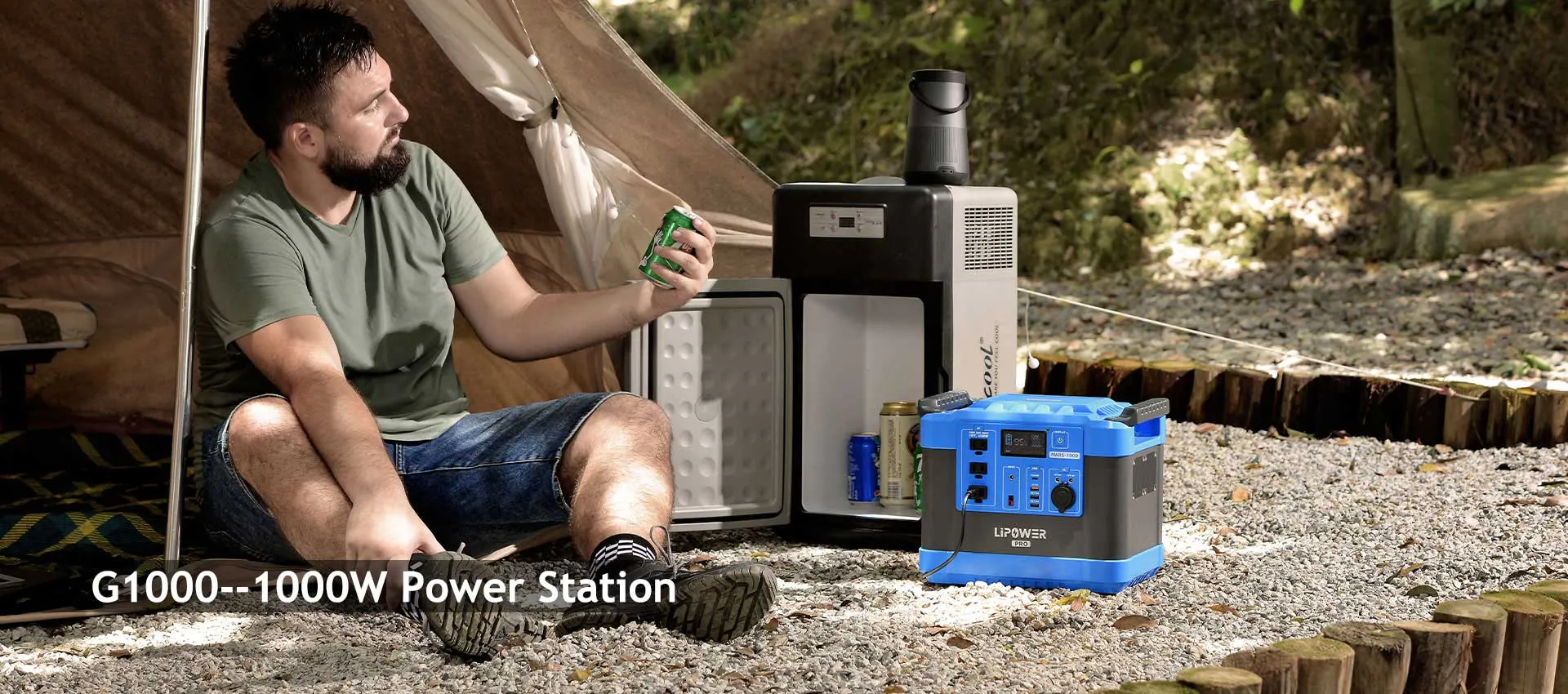
Camping & Tailgating: Power your LED string lights, portable fan, mini-fridge, phone chargers, and a small Bluetooth speaker for the entire weekend. A 1000W unit provides quiet, emission-free energy without disrupting the serenity of the outdoors.
Emergency Home Backup: During power outages, keep your Wi-Fi router, phone chargers, LED lighting, and essential medical devices running for hours until the grid comes back online.
Remote Work & Content Creation: Whether you're working from a cabin or filming on location, a 1000W station runs your laptop, monitor, drone charger, camera batteries, and lighting rigs comfortably throughout the day.
RV and Van Life: Charge all your electronics, run a mini-fridge, and keep the lights on inside your recreational vehicle — all without the need for a noisy generator.
Medical Device Support: CPAP machines, nebulizers, and other low-power medical equipment can run reliably for 12–24+ hours on a 1000W station, offering critical peace of mind during travel or power interruptions.
Limitations of a 1000W Unit and Tips for Maximizing Its Usage
Despite their versatility, 1000W stations do have boundaries. They are not designed for heavy-duty appliances like air conditioners, full-size refrigerators, space heaters, electric ovens, or induction cooktops. These devices typically draw 1,500W to 3,000W or more, which far exceeds the unit's capacity.
Similarly, appliances with high surge demands (like large compressors or high-power tools) may trip the station's overload protection even if their running wattage is below 1000W.
Here are several strategies to extend battery life and get the most from your 1000W station:
1. Prioritize Energy-Saving Devices
Choose low-power alternatives wherever possible. Use a French press instead of an electric coffee maker, LED bulbs instead of incandescent, and a slow cooker instead of an electric grill. Small swaps significantly extend battery life.
2. Give Priority to Essential Devices
When power is limited, charge the most critical devices first — phones, medical equipment, communication devices, and lighting. Less essential items can wait until you have access to a recharge.
3. Avoid Running at Full Capacity Continuously
Operating the station at or near its 1000W peak for extended periods generates excess heat and shortens battery lifespan. Keep your combined load at roughly 80% (around 800W) or less for optimal longevity.
4. Perform Basic Maintenance Regularly
Although maintenance-free in many respects, periodic steps like keeping the battery between 20–80% charge when in storage, avoiding extreme temperatures, and cleaning dust from vents will prolong its useful life.
5. Use Solar Charging for Extended Off-Grid Use
Pairing your station with a compatible solar panel allows you to replenish the battery during the day while consuming power at night — ideal for multi-day camping trips.
6. Calculate Your Needs Before You Go
Add up the wattages of all devices you plan to use simultaneously. Make sure the total stays below 1000W, and cross-check against surge ratings for any motorized appliances.
7. Handle High-Surge Devices Carefully
If you need to start a high-surge device like a mini-fridge, disconnect all other loads first. Once the fridge is running and past its startup spike, you can reconnect your other devices.
Recommended Power Station Solution
If you need a power station that goes well beyond the 1000W class while still maintaining excellent portability, the BLUETTI AC200MAX is an outstanding option. With 2,200W of output power and a massive 2,048Wh battery, it can handle larger appliances and run essential devices for significantly longer periods. Its expandable design also means you can add extra battery packs when your power needs grow.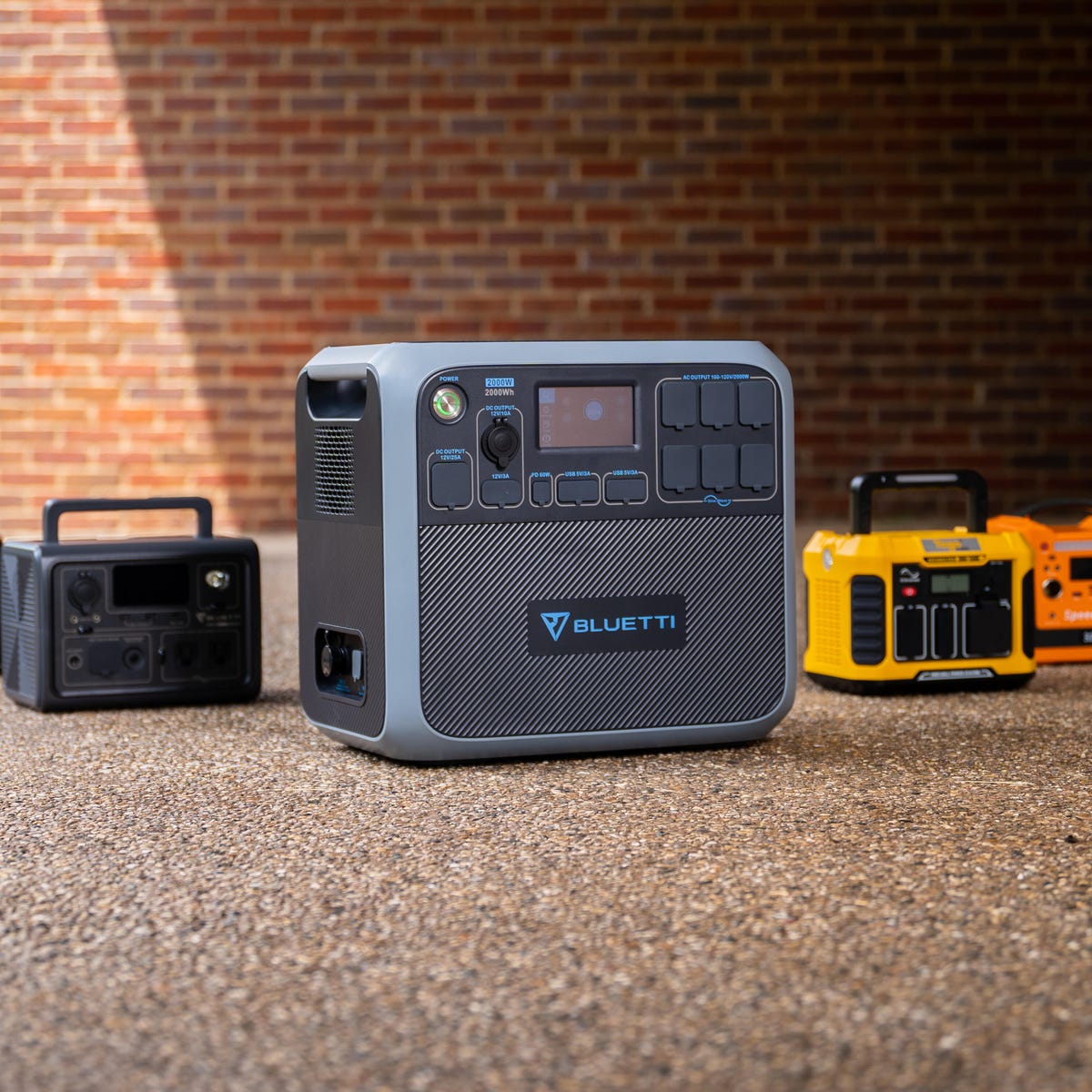
Appliance Runtime Reference
Below are estimated runtimes for common devices on different battery capacities. Use this as a quick reference to plan your power usage when selecting a station:
| Appliance | Wattage | 768Wh Battery | 1000Wh Battery | 2048Wh Battery |
|---|---|---|---|---|
| LED Light (10W) | 10W | ~65 hrs | ~85 hrs | ~174 hrs |
| Laptop (60W) | 60W | ~11 hrs | ~14 hrs | ~29 hrs |
| Mini Fridge (100W) | 100W | ~6.5 hrs | ~8.5 hrs | ~17 hrs |
| Coffee Maker (800W) | 800W | ~0.8 hrs | ~1 hr | ~2.2 hrs |
| CPAP (40W) | 40W | ~16 hrs | ~21 hrs | ~43 hrs |
Runtimes are estimates based on approximately 85% inverter efficiency. Actual performance depends on the specific power station model and conditions of use.
Frequently Asked Questions
How long can a CPAP machine run on a 1000W power station?
A typical CPAP machine draws between 30–60W. On a 1000Wh battery, you can expect approximately 14 to 28 hours of continuous use. With a humidifier turned off or on a low setting, runtimes extend even further. This makes a 1000W station an excellent companion for camping trips or as an emergency backup at home.
Can a 1000W power station replace a gas generator?
For low-to-mid power applications, absolutely. A 1000W station is quieter, cleaner, and requires no fuel or ongoing maintenance. However, if you need to power large appliances continuously — like a central air conditioner or a full-size refrigerator — a gas generator or a higher-capacity power station in the 2000W+ range would be more appropriate.
How much time does recharging a 1000W unit take?
Charging times vary by model and charging method. A standard wall outlet typically refills the battery in 1 to 2 hours for fast-charge models and up to 6–8 hours for slower units. Solar panel charging depends on panel wattage, sunlight conditions, and angle — generally ranging from 3 to 8 hours. Car charging via a 12V port is the slowest method, usually taking 6 to 12 hours.
On average, how long does a 1000W unit last per charge?
That depends entirely on the devices you connect and how much power they consume. A single smartphone charger at 10W can last 80+ hours, while a coffee maker running at 800W will drain the battery in about an hour. For a realistic mixed-use scenario (phone charging, a few LED lights, and occasional laptop use), you can typically get a full day or more on a single charge.
Can I run multiple devices at the same time?
Yes, as long as the combined wattage of all connected devices stays under 1000W. For example, a laptop (60W), a phone charger (15W), an LED light (10W), and a Wi-Fi router (15W) total just 100W — leaving plenty of headroom. Just be cautious with motorized appliances and their surge requirements.
The Bottom Line
A 1000W portable power station is a remarkably versatile tool that covers the vast majority of everyday portable energy needs. Whether you are heading out for a weekend camping adventure, preparing for unexpected power outages, working remotely from off-grid locations, or simply looking for a quiet backup power source, a 1000W unit delivers reliable performance at a manageable size and cost. Just remember to keep your total load below the rated output, plan for surge power on motorized devices, and choose energy-efficient alternatives wherever possible. For those who require additional capacity, consider a larger expandable unit that can grow with your power demands.