
Whether you run a small café, a bustling restaurant, or a large-scale catering operation, commercial refrigeration is the backbone of any food-service business. The right equipment safeguards ingredient freshness, meets health-code requirements, and keeps daily workflow running smoothly. In this guide we break down the different categories of commercial refrigerators and freezers so you can confidently choose the unit that matches your operation.
What This Guide Covers
- Types of Commercial Refrigeration & Freezers • 2. Refrigerator & Freezer Door Configurations • 3. Refrigeration & Freezer Purchasing Considerations • 4. Refrigeration & Freezer Installation Tips
Types of Commercial Refrigerators & Freezers
Regardless of whether you need a refrigerator, a freezer, or both, commercial cold-storage equipment comes in a wide range of form factors. Each style serves a particular workflow and kitchen layout. Below are the most common types you'll encounter.
1. Reach-In Refrigerators & Freezers
Reach-in units are the workhorses of commercial kitchens. Available in one-, two-, and three-section models, they allow staff to quickly grab ingredients without leaving the prep line. Their upright design keeps items at eye level, which makes inventory checks effortless and helps reduce food waste. Most models include adjustable shelving and self-closing doors to maintain consistent temperatures even during a hectic service.

Best For: Kitchens ranging from compact cafés to full-service restaurants that need fast, organized access to perishables.
2. Roll-In Refrigerators & Freezers
Roll-in models are engineered for high-volume operations. Instead of loading shelves by hand, staff roll entire sheet-pan racks or speed racks straight inside. This dramatically cuts restocking time and minimizes physical strain. If your prep area is next to a baking line or a high-output cook station, a roll-in unit ensures freshly prepared items transition to cold storage in seconds.

Best For: Bakeries, banquet halls, and any facility that moves large quantities of racked goods in and out of refrigeration.
3. Pass-Through Refrigerators & Freezers
Pass-through units feature doors on opposite sides, creating a seamless hand-off point between the kitchen and the serving line. Cooks load finished dishes from one side; servers retrieve them from the other. This layout eliminates unnecessary foot traffic, reduces cross-contamination risk, and keeps service times short during peak hours.

Best For: Restaurants, hotels, and institutional kitchens where the prep area and service area are on opposite sides of a wall or counter.
4. Walk-In Coolers & Freezers
When you need to store large volumes of produce, proteins, or frozen goods, a walk-in is the answer. These room-sized units can be custom-built to match your available floor space and can even be installed outdoors with proper weatherproofing. Walk-ins maintain rock-steady temperatures throughout and are indispensable for operations that receive bulk deliveries on a weekly or bi-weekly schedule.

Best For: Grocery stores, large restaurants, catering companies, and any business that handles high-volume inventory.
5. Undercounter Refrigerators & Freezers
Undercounter units tuck neatly beneath prep tables and countertops, making them a smart space-saving choice for smaller kitchens and bar areas. They keep frequently used garnishes, sauces, and proteins within arm's reach, cutting unnecessary trips to a larger cooler. Despite their compact footprint, many models offer surprisingly generous storage capacity.

Best For: Bars, food trucks, small cafés, and prep stations that demand cold storage without sacrificing counter workspace.
Types of Refrigerator & Freezer Doors
Once you have settled on a form factor, the next decision is door style. Each configuration offers distinct advantages depending on how often the unit is accessed, what kind of visibility you need, and the spatial constraints of your kitchen.
Swing Doors
Swing doors are the most traditional and widely used configuration. They pivot outward on hinges, granting broad access to every shelf. Some commercial models feature field-reversible hinges so you can change the opening direction after installation to suit your layout. They are reliable, easy to maintain, and suit virtually every environment.
Best For: Standard commercial kitchens with adequate clearance in front of the unit.
Half Doors
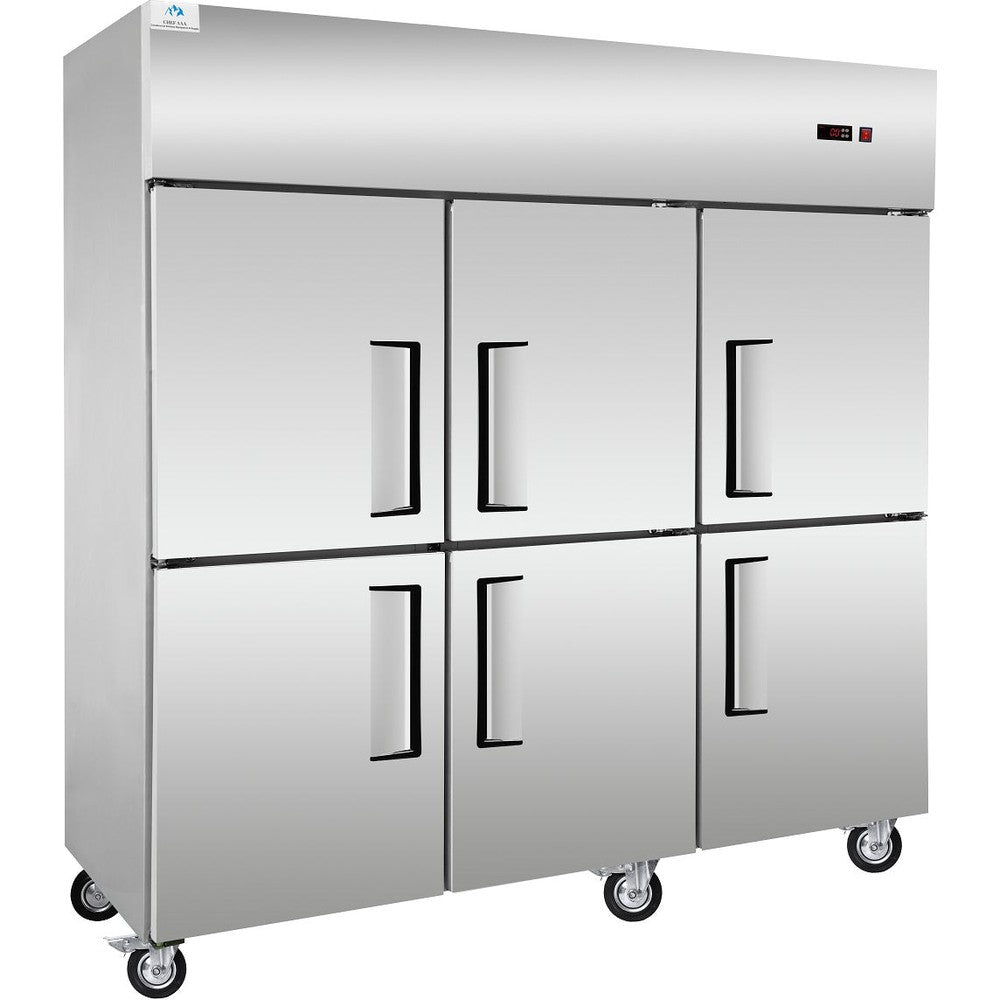
Half-door designs split each section into an upper and lower compartment. Only the section you need opens at any given time, which drastically reduces cold-air loss. This translates into lower energy bills and more stable internal temperatures — a significant advantage in fast-paced kitchens where doors open and close dozens of times per hour.
Best For: High-traffic kitchens focused on temperature stability and energy efficiency.
Drawers
Drawer-style refrigerators and freezers offer a low-profile, pull-out design that works brilliantly beneath counters and cook lines. They keep ingredients at waist height for ergonomic access and limit cold-air escape because only a narrow drawer opens at a time. Many professional kitchens pair drawer units with undercounter models for maximum flexibility.
Best For: Line cooks and prep stations where speed and ergonomics matter.
Glass Doors
Glass-door units let you see exactly what is inside without opening the unit, reducing unnecessary cold-air loss and making it simple to spot low stock at a glance. They are popular in front-of-house applications such as display merchandisers and beverage coolers. Modern double- or triple-pane glass significantly reduces condensation and improves energy performance.
Best For: Retail displays, beverage service, and any scenario where visual inventory checks are valuable.
Strip Curtains
Strip curtains consist of overlapping flexible plastic strips that hang in the doorway. They provide a barrier against warm air while allowing personnel to walk through hands-free — ideal for walk-in coolers and freezers where staff frequently enter and exit carrying heavy loads. They are inexpensive to replace and dramatically cut energy costs.
Best For: Walk-in units with high foot traffic.
Commercial Refrigerator & Freezer Purchasing Considerations
Selecting the right unit involves more than just picking a size. Here are the key factors you should weigh before making a purchase.
Door Transparency
Solid doors provide superior insulation and are best for back-of-house storage. Glass doors let staff and customers view contents without opening the unit, which saves energy and aids merchandising. Choose based on whether visibility or insulation is more important to your workflow.
Compressor Location
Top-mounted compressors keep the motor out of the dust and grease zone near the floor, making maintenance easier and extending the unit's lifespan. Bottom-mounted compressors lower the centre of gravity and make loading top shelves more convenient. Consider your kitchen's ambient temperature and cleaning schedule.
Removable Gaskets
Door gaskets are critical for maintaining an airtight seal. Over time they wear out, crack, or accumulate grime. Units with snap-in, tool-free gaskets make replacement quick and affordable — keeping energy costs down and food safety standards high.
Digital Thermostat
Precise temperature control is non-negotiable for food safety. Digital thermostats with LED displays let you monitor and adjust temperatures at a glance. Many modern models also include high-temperature alarms and diagnostic codes, giving you an early warning before problems escalate.
Spec Line vs. Standard Duty
Standard-duty refrigerators handle everyday storage needs reliably and come at a lower price point. Spec-line models are built to endure heavier use, featuring thicker insulation, sturdier hinges, and more powerful compressors. If your unit will see constant use in a demanding environment, the upfront premium for spec-line pays off over time.
Energy Efficiency
Refrigeration runs around the clock, so even modest efficiency gains add up. Look for ENERGY STAR-rated models and high-efficiency compressors. LED interior lighting, automatic door closers, and quality insulation all contribute to lower operating costs month after month.
Refrigeration & Freezer Installation Considerations
Even the finest commercial refrigerator will underperform if it is improperly installed. Keep these guidelines in mind before your new unit arrives.
Measure Door Frames & Hallways
Before purchasing, measure every doorway, corridor, and elevator the unit must pass through. Check the height with casters attached. It is far easier to verify clearance in advance than to deal with a refrigerator that cannot reach its intended location.
Observe Clearance Guidelines
Manufacturers specify minimum clearance on the back and sides to ensure proper airflow around the condenser. Ignoring these specifications can cause the compressor to overwork, drive up electricity bills, and shorten the unit's lifespan.
Install on a Level Surface
An uneven floor can prevent doors from sealing correctly, leading to temperature fluctuations and excess energy consumption. Use adjustable legs or casters with locks to achieve a perfectly level installation.
Ensure Proper Power Supply
Verify that your electrical circuit matches the voltage, amperage, and plug type listed on the unit's spec sheet. Dedicated circuits are strongly recommended to prevent tripped breakers during peak-demand periods.
Featured Product
Chef AAA 72" Reach-In Freezer — 6 Solid Half Doors
Built for demanding commercial kitchens, this 72-inch reach-in freezer pairs six half-door sections with heavy-duty construction to deliver outstanding temperature consistency and energy savings.
Investing in the right commercial refrigerator or freezer is one of the smartest moves any food-service operator can make. Proper cold storage protects your inventory, keeps health inspectors happy, and streamlines daily operations. Take time to match the unit type, door style, and features to your specific workflow — and pay close attention to installation details so your equipment delivers peak performance from day one.
Browse the full selection of commercial refrigeration and freezer equipment at Backyard Provider to find the unit that fits your space, your budget, and your ambitions.