
So you've decided on an in-ground hoop — a permanent fixture that elevates your backyard game to the next level. The right choice comes down to four essential factors: Size & Shape, Stability, Rim & Backboard options, and Price. Let's walk through each one so you can make a confident, informed decision.
The Framework
Four Factors That Define the Right Hoop
Size & Shape
Backboard Size
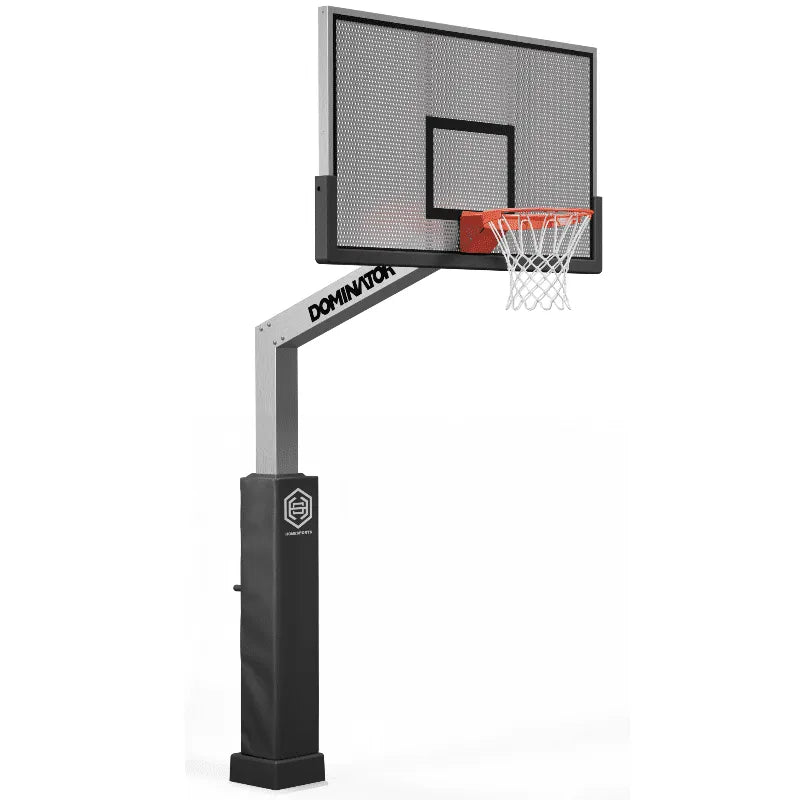
Backboards range from 44" to a full 72" — the regulation size used at every level of competitive play. Smaller boards in the 44"–54" range save space and cost, making them popular for tighter driveways or yards where room is limited. However, a 72" board is the benchmark for anyone serious about developing their game or replicating the true NBA feel. It offers the most generous rebound surface and is essential for authentic bank-shot practice.
Pole Size
When it comes to the pole, bigger is better. Many in-ground systems come with 4.5", 5", or 6" square poles. The wider the pole, the more structural support it provides for the backboard — meaning less flex, less vibration, and a more solid feel on every shot and rebound.
Backboard Shape: Rectangle vs. Fan
Rectangular Backboard
The most common shape used at every level from high school to the pros. The additional surface area on all sides gives players more room to work with on rebounds and bank shots, making it the preferred choice for competitive or skill-focused play.
Fan-Shaped Backboard
A fan backboard takes up less physical space, making it a popular option for smaller outdoor areas or casual recreational use. While it functions well for shooting games, it's less commonly found in competitive or training-focused setups.
Stability
A wobbly hoop is more than an annoyance — it disrupts your shot, shortchanges your rebounds, and affects every aspect of how you play. Several elements contribute to how stable your in-ground hoop will be.
The Anchor System
Your anchor is the foundation of everything. There are two main anchor types used in residential in-ground hoops: the hinge anchor and the J-bolt anchor. These are NOT interchangeable — the anchor type determines the installation method and dictates how easily you can relocate the system in the future.
The hinge system creates a more solid connection by distributing load more effectively beneath the surface. It reaches a depth of 42" — significantly deeper than the J-bolt standard. Greater depth means less susceptibility to ground movement, vibration, and long-term shifting. Relocating the hoop is straightforward: simply detach the pole from the anchor at ground level without disturbing the foundation.
The J-bolt anchor is the industry default, setting the pole at a shallower 18" depth. While widely used, this design is more prone to vibration and flex over time. Rebars are typically required to reinforce the concrete pour for added stability. Moving the hoop means breaking out the concrete entirely and starting the installation from scratch.

The Pole
Your pole is the structural spine of the entire system. A heavy-duty pole minimizes vibration and prevents the backboard from shaking after contact — crucial for ensuring the ball responds consistently on every shot. When evaluating poles, look for these qualities:
- Thick steel walls — Poles should be at least 3/16" thick (roughly 11-gauge or thicker). Thinner steel means more flex and instability.
- One-piece pole construction — A single-section pole is stiffer and more resistant to corrosion. Sectioned poles introduce connection points that can weaken and loosen with use.
- Square poles outperform round — Square cross-sections provide significantly more structural rigidity than round poles of the same steel thickness.
- Corrosion-resistant coating — A quality finish protects the pole from the elements, extending the life of your investment by years.

Support Arms
The support arms connecting your pole to the backboard also play a key role in system stability. Wider support attachments reduce backboard flex, improve ball bounce consistency, and deliver a noticeably more responsive hoop experience — especially when shooting from various angles or practicing off the glass.
Rim & Backboard Options
The Rim
The standard basketball rim is 18" in diameter. In-ground systems offer two primary rim types — fixed height and adjustable height. For households with players of different ages and skill levels, an adjustable rim is the more versatile investment. Being able to lower the rim allows younger players to develop proper shooting form and experience real success on the court.
Spring-Loaded vs. Fixed Rim: What to Know
- A spring-loaded rim absorbs the energy of a hard dunk or slam, reducing stress on the backboard and pole.
- After contact, the spring mechanism returns the rim to its horizontal position — maintaining consistent play.
- Some lower-priced hoops ship with the spring exposed; higher-end models enclose it to prevent pinching.
- Fixed rims offer simplicity and durability for households focused on shooting and skill-building over dunking.
- If children will be using the hoop, adjustability is key — height cranks should be easy to operate at ground level.
The Backboard
Your backboard directly shapes how the ball responds off the glass. There are three main materials used across in-ground basketball systems:
Tempered Glass
The professional standard. Tempered glass delivers the same ball response you'd find on an NBA court — true, consistent, and satisfying. It's the top choice for anyone serious about developing their game or achieving the most authentic backyard court experience possible.
Acrylic
A cost-effective middle ground. Acrylic boards offer good visibility and reasonable performance but won't deliver the high-caliber ball response of glass. Designed to be lightweight, they're a solid pick for casual play where bank-shot precision isn't the priority.
Polycarbonate
The most budget-friendly option. Polycarbonate boards are impact-resistant and lightweight, making them highly durable for casual recreational use. However, the ball response is noticeably inferior to acrylic or glass, so players focused on improving their skills should consider stepping up in material.
Price & What It Means for Quality
As with most major backyard investments, you get what you pay for. Basketball hoops are no different. Entry-level systems are more affordable but come with trade-offs: thinner steel, lighter backboards, simpler anchor systems, and reduced longevity. Premium systems offer thicker poles, regulation-grade glass backboards, deeper anchor depths, and the kind of build quality that stands up to years of serious play.
A good rule of thumb: focus first on the factors that matter most to your situation — whether that's portability, backboard size, rim adjustability, or long-term durability — and let those priorities guide your budget. The right hoop isn't necessarily the most expensive one; it's the one that best matches how you actually play.
Ready to Upgrade Your Backyard Court?
Explore our professional-grade in-ground basketball hoops — built for players who take their game seriously.
Dominator 72" Hoop