
Selecting between monocrystalline and polycrystalline solar panels represents one of the most significant decisions homeowners face when transitioning to renewable energy. Understanding the fundamental differences between these two technologies will empower you to make an investment that perfectly aligns with your energy requirements, available space, and financial goals.
Essential Differences at a Glance
Efficiency Rating
Investment Range
Space Requirements
Longevity
Understanding Monocrystalline Technology
Monocrystalline solar panels represent the pinnacle of photovoltaic engineering, constructed from single-crystal silicon wafers that have been meticulously refined for maximum energy conversion. The manufacturing process begins with exceptionally pure silicon, which undergoes a sophisticated crystallization procedure called the Czochralski method, resulting in a perfectly uniform molecular structure.

This uniform crystalline arrangement allows electrons to flow more freely when activated by sunlight, translating to superior efficiency rates that consistently outperform alternative technologies. Modern monocrystalline panels routinely achieve efficiency ratings between 20-23%, with premium models reaching even higher through advanced cell architectures and anti-reflective coatings.
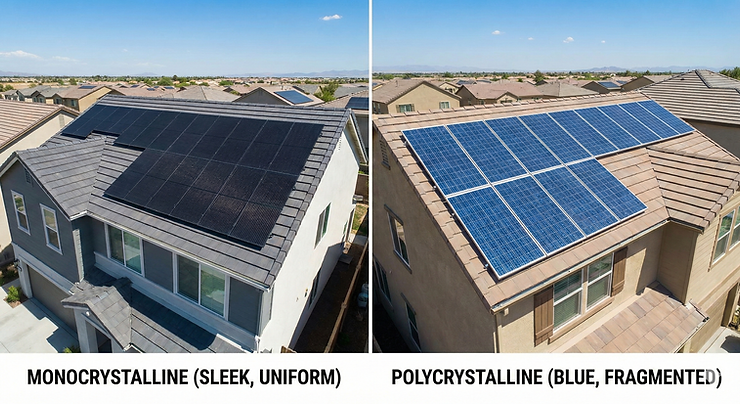
Why Consider Monocrystalline? When your roof space comes at a premium, these high-efficiency panels deliver maximum power generation from every square foot available. The sleek black appearance also provides an aesthetically pleasing look that many homeowners appreciate.
Monocrystalline Advantages
Key Benefits
- Industry-leading efficiency ratings of 20-23%
- Compact installation footprint
- Superior heat tolerance performance
- Elegant black aesthetic appearance
- Longer manufacturer warranties available
- Better low-light performance
Considerations
- Higher upfront investment required
- More complex manufacturing process
- Slightly more sensitive to shading
Understanding Polycrystalline Technology
Polycrystalline solar panels offer an accessible entry point into solar energy through a more streamlined manufacturing approach. Rather than growing individual silicon crystals, manufacturers melt multiple silicon fragments together and allow them to cool into molds, creating panels with a distinctive blue-speckled appearance that reveals their multi-crystalline composition.

This simplified production method results in meaningful cost savings that manufacturers pass along to consumers. While the multiple crystal boundaries within each cell create minor resistance to electron flow, reducing overall efficiency to the 15-17% range, the economic advantages make polycrystalline panels an attractive option for installations where space constraints are minimal.
Recent technological innovations have steadily improved polycrystalline performance, narrowing the efficiency gap with monocrystalline alternatives. Major manufacturers continue investing in polycrystalline research, recognizing that cost-effective solar solutions remain essential for widespread renewable energy adoption.
Polycrystalline Advantages
Key Benefits
- Significantly lower purchase price
- Proven reliability over decades
- Less manufacturing waste produced
- Good performance in various conditions
- Shorter investment payback period
Considerations
- Lower efficiency requires more panels
- Larger installation area needed
- Blue appearance may not suit all homes
- Slightly lower heat tolerance
Direct Technology Comparison
Monocrystalline
- Single crystal structure
- 20-23% efficiency rating
- Sleek black appearance
- Premium pricing tier
- Compact space requirements
- Superior heat tolerance
Polycrystalline
- Multiple crystal fragments
- 15-17% efficiency rating
- Blue speckled appearance
- Budget-friendly pricing
- Larger area required
- Good overall performance
Performance Across Climate Conditions
Temperature significantly impacts solar panel efficiency, and understanding how each technology responds to heat helps optimize your system design. All solar panels experience some efficiency reduction as temperatures climb, but the degree of degradation varies between technologies.
| Performance Factor | Monocrystalline | Polycrystalline |
|---|---|---|
| Temperature Coefficient | -0.35% to -0.40% per °C | -0.40% to -0.45% per °C |
| Low-Light Performance | Excellent | Good |
| Hot Climate Suitability | Very Good | Good |
| Shade Tolerance | Moderate | Moderate |
| Annual Degradation | 0.3-0.5% | 0.5-0.7% |
Homeowners in consistently warm climates often benefit more from monocrystalline panels due to their superior temperature coefficients, maintaining higher output when heat would otherwise diminish performance. Conversely, those in moderate climates may find polycrystalline panels deliver excellent value without the premium pricing.
Investment and Cost Analysis
Evaluating the true cost of solar panels requires looking beyond initial purchase price to understand long-term value generation. While monocrystalline panels demand higher upfront investment, their superior efficiency often delivers better lifetime value through increased energy production over decades of operation.

Initial Investment
25-Year Production
Selecting Your Ideal Panel Type
Choose Monocrystalline When:
Monocrystalline panels excel in situations where maximizing power output per square foot matters most. Homeowners with limited roof space, complex roof geometries, or significant shading challenges benefit tremendously from the higher efficiency these panels provide. Additionally, those planning to remain in their home long-term will appreciate the superior lifetime energy production.
- Your available installation area is restricted
- You prioritize maximum long-term energy production
- Aesthetic appearance matters to your home's curb appeal
- You live in a consistently hot climate
- Future system expansion may be limited by space
Choose Polycrystalline When:
Polycrystalline panels make excellent financial sense when abundant installation space eliminates efficiency concerns. Ground-mounted systems, large commercial rooftops, and expansive residential properties can achieve equivalent power generation at lower cost by simply installing additional panels.
- Budget optimization is your primary concern
- You have ample roof or ground-mount space
- Achieving fastest payback period matters most
- You live in a moderate climate zone
- Panel appearance is not a significant factor
Our Expert Recommendation 2025 Guide
For most residential installations in 2025, we recommend monocrystalline panels as the optimal choice. The efficiency advantages translate to meaningful long-term savings that typically outweigh the initial price premium, especially as electricity costs continue rising nationwide.
The superior aesthetics, excellent heat tolerance, and reliable performance make monocrystalline technology the gold standard for homeowners seeking maximum value from their solar investment. However, budget-conscious buyers with extensive installation space should absolutely consider polycrystalline panels as a proven, cost-effective alternative.
Frequently Asked Questions
Are monocrystalline panels truly worth the extra cost?
Why are polycrystalline panels becoming less common?
How does hot weather affect panel performance?
Can I mix panel types in one installation?
Ready to Power Your Home with Solar Energy?
Discover our premium selection of high-efficiency solar panels designed to maximize your energy independence. Our expert team is ready to help you find the perfect solution for your home.
EcoFlow 400W Rigid Solar Panel