
In This Article
- ▸ 750W Electric Bike Speed Overview
- ▸ Pedal-Assist vs. Throttle Mode
- ▸ Real-World vs. Advertised Speed
- ▸ Factors Affecting 750W E-Bike Speed
- ▸ 750W Electric Bike Laws & Classes
- ▸ Electric Bike Comparison: 750W vs. Others
- ▸ 750W E-Bikes in Real Life
- ▸ FAQ
750W Electric Bike Speed
The 750-watt motor is the sweet spot for electric bikes in the United States. It delivers enough power for commuting, light trail riding, and hauling cargo without crossing into moped territory. Here's a breakdown of what you can expect speed-wise under different riding conditions.
| Riding Condition | Speed Range | Typical Average |
|---|---|---|
| Flat road, throttle only | 20–25 mph | ~22 mph |
| Flat road, pedal-assist | 25–28 mph | ~26 mph |
| Uphill (moderate grade) | 10–18 mph | ~14 mph |
| Off-road / gravel | 12–20 mph | ~16 mph |
| Heavy rider (250+ lbs) | 16–22 mph | ~19 mph |
⚠️ Always follow local laws and ride safely. Electric bikes must obey speed limits for your safety and the safety of others.
How Fast Does a 750W Electric Bike Go?
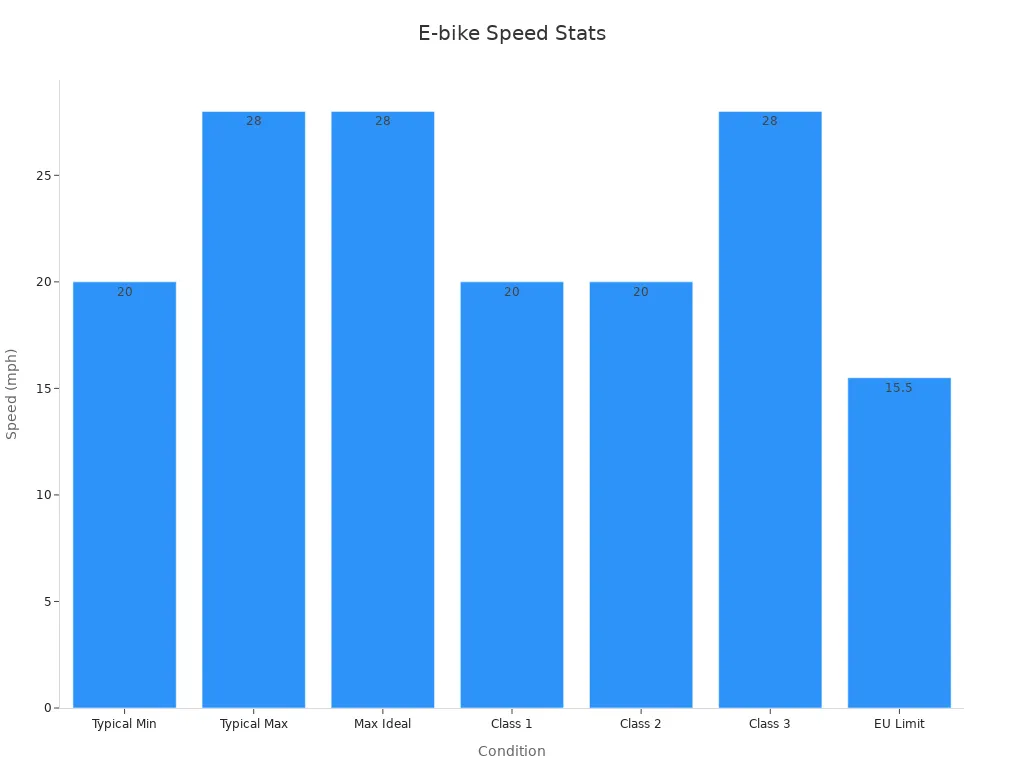
Under ideal conditions — a flat surface, fully charged battery, and a rider weighing around 150–180 lbs — most 750W e-bikes will comfortably cruise between 20 and 28 mph. That's faster than the average cyclist can sustain and plenty quick for daily commutes, errands, or recreational rides.
That said, the number on the spec sheet doesn't always match the number on your speedometer. Several real-world variables can push that figure up or bring it down. Motor efficiency, tire pressure, wind resistance, and even the type of controller your bike uses all play a role.
Think of 750 watts as the ceiling — the maximum power output your motor is capable of producing. In day-to-day riding, you'll rarely sustain peak wattage for long stretches. Instead, the motor modulates its output based on how you ride, which is why understanding the difference between pedal-assist and throttle modes matters so much.
Pedal-Assist vs. Throttle Mode
These two riding modes define the entire experience on a 750W electric bike, and each one delivers noticeably different top speeds.
Pedal-Assist
25–28 mph
Pedal-assist combines your pedaling effort with motor power. The harder you pedal, the more the motor kicks in. Most systems offer 3 to 5 assist levels, letting you dial in exactly how much help you want.
This mode typically delivers the highest top speed because your own leg power supplements the motor. It also extends battery range significantly — often by 30% or more compared to throttle-only riding.
Throttle Only
20–25 mph
Throttle mode is the twist-and-go option. No pedaling required — just grip the throttle and the motor does all the work. It's effortless and perfect for riders who want a motorcycle-like experience.
The tradeoff? Lower top speeds and faster battery drain. Since you're relying entirely on the motor, it works harder and depletes the battery quicker. Most 750W bikes cap throttle mode at 20 mph to comply with Class 2 regulations.
| Feature | Pedal-Assist | Throttle Only |
|---|---|---|
| Top Speed | 25–28 mph | 20–25 mph |
| Pedaling Required | Yes | No |
| Battery Range | 35–60 miles | 20–35 miles |
| Exercise Benefit | High | Low |
| Best For | Commuting, fitness, long rides | Leisure, accessibility, easy trips |
Real-World Speed vs. Advertised Speed
Manufacturers test their bikes under laboratory conditions — smooth rollers, no wind, optimal temperature, and a lightweight test rider. In the real world, things are different. You'll encounter headwinds, rough pavement, temperature changes, and the natural drag of your own body and gear.
As a general rule, expect your actual top speed to land about 2–5 mph below the manufacturer's claimed maximum. If a bike is advertised at 28 mph, you'll likely see 23–26 mph in everyday conditions. That's perfectly normal and nothing to worry about.
| Metric | Advertised | Real-World |
|---|---|---|
| Max Speed (Pedal-Assist) | 28 mph | 23–26 mph |
| Max Speed (Throttle) | 25 mph | 20–23 mph |
| Battery Range | 50–60 miles | 30–45 miles |
Note: The fastest recorded speeds for an e-bike with a 750W motor usually require aggressive pedaling and near-perfect conditions. Most riders will never sustain peak velocity for more than a few seconds at a time.
Factors Affecting 750W E-Bike Speed
Your actual cruising speed depends on a handful of key variables. Understanding them helps you optimize your ride and set realistic expectations.
Rider Weight
Weight is the single biggest factor affecting your speed. A lighter rider (under 150 lbs) can expect to hit the upper end of the speed range, while heavier riders (220+ lbs) will notice a drop of 3–5 mph. It's basic physics — more mass requires more energy to accelerate and maintain speed.
Don't forget to account for cargo. Panniers, backpacks, groceries, and other gear add up fast and will affect your speed just like body weight does.
Terrain and Surface
Smooth, flat pavement is where 750W motors shine brightest. Throw in a hill, a gravel path, or a sandy trail and your speed will decrease noticeably. Even gentle inclines of 5–8% can cut your speed by a third.
Tire type matters here too. Fat tires (4" wide) provide excellent grip on soft surfaces but create more rolling resistance on pavement. Narrower tires roll faster on roads but struggle off-road. Choose based on where you ride most.
Battery and Motor Type
Not all 750W motors are created equal. Hub motors (mounted in the wheel) are simpler and cheaper but tend to be slightly less efficient than mid-drive motors (mounted at the pedals). Mid-drive systems leverage your gears, giving you better torque on hills and generally higher effective speeds.
Battery voltage matters too. A 48V battery paired with a 750W motor will deliver more consistent power at higher speeds than a 36V setup. As your battery drains below 30%, you'll notice a gradual decrease in top speed and acceleration.
Weather Conditions
A strong headwind can easily knock 3–5 mph off your speed, while a tailwind can boost you beyond your normal cruising pace. Cold temperatures also reduce battery performance — lithium-ion cells lose efficiency below 40°F, which translates to reduced range and slightly lower speeds.
Rain and wet roads won't directly slow your motor, but they reduce traction and increase braking distances. Riding conservatively in wet conditions is always the smart move.
💡 Pro Tip
Always check the weather forecast before heading out. Adjust your expected speed and range to match the conditions for a safe, enjoyable trip.
750W Electric Bike Laws
Electric Bike Speed Laws
In the United States, 750 watts is the federal maximum for electric bikes. That means your 750W e-bike is legal at the federal level, but individual states set their own rules about where you can ride and how fast you're allowed to go. Most states have adopted the three-class system, which categorizes e-bikes by their speed capabilities and motor engagement type.
🔎 Tip: Most states do not require a license for 750W e-bikes, but helmet and age rules can change by location. Always verify your local regulations before riding.
E-Bike Classes
| Class | Motor Type | Max Speed | Throttle | Where Allowed |
|---|---|---|---|---|
| Class 1 | Pedal-Assist | 20 mph | No | Bike lanes, paths, roads |
| Class 2 | Throttle + PAS | 20 mph | Yes | Bike lanes, paths, roads |
| Class 3 | Pedal-Assist | 28 mph | Varies | Roads, some bike lanes |
Compliance Tips
Staying legal is straightforward if you follow a few basic principles. First, know your bike's class — this determines where you can legally ride. Second, respect posted speed limits in bike lanes and multi-use paths. Third, wear a helmet if your state requires one (and even if it doesn't, you should). Finally, make sure your bike has proper lighting and reflectors for evening rides.
Note: Federal law (16 CFR Part 1512) covers safety features like brakes, reflectors, and frame integrity. Keeping your bike in good shape and following these standards helps you ride safely and stay compliant.
Electric Bike Comparison
750W vs. 1000W
If you want a balance of speed and range for city riding, the 750W motor is the better choice. It sits within the legal limit in most states, offers respectable speed, and delivers solid battery life. The 1000W option gives you more raw power, but it may not be street-legal in your area, consumes battery faster, and is generally heavier. For most riders, 750 watts hits the sweet spot.
750W vs. 500W
The 500W motor works well for flat terrain and lighter riders, but it struggles on hills and with heavier loads. The 750W motor gives you a meaningful bump in both top speed and hill-climbing ability without a dramatic increase in cost or weight. If you live in an area with any kind of elevation change, the extra 250 watts makes a noticeable difference.
✓ Pros of 750W
• Federally legal at 750W maximum
• Great balance of power and efficiency
• Handles hills and cargo with ease
• Wide selection of bikes available
• Suitable for most rider weights
✗ Cons of 750W
• Heavier than lower-wattage bikes
• Higher price point than 500W models
• Battery drains faster at full power
• Some trails restrict higher-powered e-bikes
• Overkill for very flat, short commutes
750W E-Bikes in Real Life
Urban Riding
City commuters love the 750W class because it keeps up with traffic without breaking a sweat. A typical urban rider reports cruising at 18–22 mph through city streets, which is fast enough to match the flow of traffic in most 25 mph zones. Stop-and-go riding does reduce your average speed, but the motor's instant torque makes accelerating from lights effortless.
Many commuters note that although the manufacturer may advertise a top speed of 28 mph, steady urban riding with traffic signals, turns, and pedestrians brings the practical average down to around 15–20 mph. That's still significantly faster than cycling unassisted, and you arrive without being drenched in sweat — a major perk for anyone commuting to work.

Off-Road Use
Taking a 750W electric bike off-road is where things get interesting. Fat-tire models with knobby treads handle gravel, dirt, and packed trails admirably. Speeds typically range from 12–18 mph on moderate trails, dropping lower on steep or technical sections.
The 750W motor provides enough torque to climb hills that would stop a traditional bike dead in its tracks. That's a game-changer for trail riders who want to explore more terrain without turning every ride into an exhausting workout. Just be mindful of local trail regulations — some nature preserves and singletrack trails restrict or ban motorized bikes, including e-bikes.
Featured Product
Ready to Experience 750W Power?

Discover the ENGWE L20 — a 48V/13Ah 750W electric bike built for city streets, backyard adventures, and everything in between.
ENGWE L20 750W E-Bike →Frequently Asked Questions
How fast can you legally ride a 750W electric bike?
In most states, Class 1 and Class 2 e-bikes are limited to 20 mph, while Class 3 e-bikes can reach 28 mph with pedal assist. Your bike's class determines the legal speed limit, not its wattage alone. Always check your state's specific regulations since they can vary.
Does a 750W e-bike need a license or registration?
In the vast majority of states, no. As long as your e-bike meets the 750W federal limit and falls within one of the three recognized classes, you can ride it without a driver's license, registration, or insurance. A few states have additional requirements, so it's worth verifying your local rules.
How fast can you charge a 750W e-bike?
Most 750W e-bike batteries take between 4 and 6 hours to charge from empty to full using the included charger. Some models offer fast-charge options that can get you to 80% in about 2–3 hours. To maximize battery lifespan, avoid draining it completely and try to keep the charge between 20% and 80% during normal use.
Can you ride a 750W e-bike in the rain?
Yes, most 750W e-bikes are rated for water resistance (usually IP65 or IP67), meaning they can handle rain and splashes without issue. However, you should avoid submerging the motor or battery in deep water. After riding in heavy rain, wipe down the electrical connections and let the bike dry before charging.
How do you make your 750W e-bike last longer?
Keep your battery charged within the optimal range (20–80%), maintain proper tire pressure, clean the chain regularly, and store the bike in a dry location away from extreme temperatures. Using pedal-assist instead of throttle-only mode extends both battery life and the lifespan of your motor. Regular brake and drivetrain maintenance keeps everything running smoothly for years.