
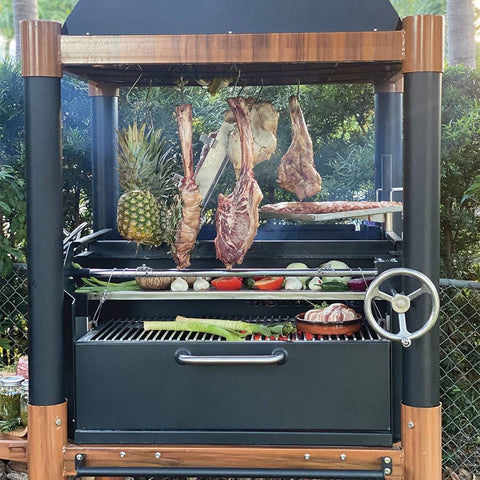
- Designed for large-surface, multi-zone cooking — ideal for delicate items and bold cuts grilled simultaneously
- Height-adjustable grates give you hands-on control over live fire rather than relying on knobs and timers
- The design is refined, clean, and deceptively simple — no extra features, no clutter, nothing that gets in your way
The asado grill has its roots in the open pampas of Argentina, where cooking over wood fire isn't a weekend hobby — it's a way of life. What the asador perfected over generations is an approach to heat and patience that no gas burner can replicate. Today, that tradition arrives in your backyard in stainless steel, built for performance and built to last.
The gaucho grill functions through radiant heat from glowing wood coals rather than open flame. This creates an environment that gently renders fat, builds bark, and imparts smoke flavor with remarkable precision. The cook controls everything through grate position — that's it. That simplicity is exactly the point.
Understanding what makes these grills distinctive helps you choose the right setup and use it to its full potential.
A side firebox where logs are burned down into coals. The brazero feeds the main cooking surface without exposing food to raw, unpredictable flame — the cornerstone of asado cooking.
Wide-spaced V-shaped rods channel fat efficiently, promote even heat distribution, and allow smoke to rise naturally. Designed to support everything from thick steaks to whole fish.
Raise or lower the grate to control the intensity of heat reaching your food. This is the asado cook's primary tool — a crank or pulley mechanism that replaces every dial on a conventional grill.
A solid steel griddle surface positioned alongside the grate. Perfect for eggs, vegetables, sauces, and anything that benefits from direct steel contact and uniform temperature.

One of the underappreciated advantages of an asado grill is its width. Unlike a kettle or barrel grill with a single temperature zone, a well-set-up Argentine grill allows you to manage multiple proteins and sides simultaneously — each at its ideal temperature.
- Build your coal bed on one side of the grill only, using properly seasoned hardwood for the cleanest burn and most stable heat output.
- Once coals are glowing and ash-white, use a shovel to distribute them beneath the grate zones you intend to use, creating a gradient from high to low heat.
- Raise or lower the grate with the height adjuster based on what you're cooking — closer for high sear, higher up for slow roasting over gentle radiant heat.
- Keep a small reserve of fresh coals from the brazero on hand to replenish if a cook runs long — never let the heat die mid-session.
Pro tip: The beauty of live-fire cooking is reading your food, not your timer. Thick brisket cuts and whole ribs need 40–60 minutes at a raised grate. Thin cuts like skirt steak or chorizo go close to the coals for 4–6 minutes. The grill tells you when it's time to move.
Both cooking surfaces serve distinct purposes and knowing when to swap between them is what separates a confident asado cook from a great one.
Proteins that benefit from fat drip, smoke, and char. Beef ribs, whole chicken, lamb, sausage, and bone-in cuts are all at home here. The airflow and open surface make for superior bark development.
Eggs, delicate fish, vegetables, flatbreads, and sauces. Anything that would fall through the grate or needs uniform contact heat belongs on the plancha. It's one of the most underused tools in an outdoor kitchen.
Not all open-fire Argentine grills are built equally — the design you choose shapes every cook you'll ever do on it.
- Standard Asado Grills: Vertical adjustable grates with a brazero on the side. Most flexible configuration for home cooks and small to mid-sized gatherings. Best suited for those new to live-fire cooking.
- Santa Maria Grills: Feature a horizontal grate on a winch or crank system, often with a wider cooking surface. Preferred for events and large-scale entertaining where consistency and capacity matter most.
- Argentine Parrilla Style: A more permanent masonry-built structure, often set into an outdoor kitchen or patio. Higher investment but unmatched in thermal retention and visual presence.

Two primary decisions shape every purchase: material and size. Get these right and the grill pays for itself in years of use.
Material: Stainless Steel vs. Carbon Steel vs. Mixed
- Stainless steel resists corrosion, requires minimal maintenance, retains appearance long-term, and is the preferred choice for outdoor exposure.
- Carbon steel is lighter and often less expensive, but demands regular seasoning and careful storage. Excellent thermal retention is its main advantage.
- Mixed construction grills combine a stainless frame with carbon steel grate components — a practical middle-ground for performance and longevity.
Recommended Size by Party Count
| Guests | Grill Width (approx.) | Ideal Use |
|---|---|---|
| 2–4 people | 36–48 in (90–122 cm) | Family dinners, compact patios, starter setup |
| 4–8 people | 48–60 in (122–152 cm) | Weekend gatherings, versatile mid-range option |
| 10–20+ people | 72–120 in (183–305 cm) | Large events, catering, serious outdoor kitchens |
One of the distinguishing capabilities of a full-size Argentine grill is the ability to run multiple preparations simultaneously across different heat zones and surfaces.
- Position thick ribeyes and short ribs directly over the hottest coal zone for the first phase of the cook, then raise the grate to finish low and slow.
- Slide vegetables and bread onto the plancha beside the main grate while proteins rest — the carry-over heat from the coals keeps it at the perfect temperature.
- Use the outer edges of the grate, furthest from the coals, as a holding zone to keep finished items warm without overcooking while the rest of the meal catches up.
The result: An entire meal — protein, vegetables, bread, and sides — all finished at the same time, served together, with no microwave in sight. That's the asado promise.
In Argentina, the asado is never rushed. The asador starts the fire well before guests arrive — sometimes an hour or more ahead — allowing the coals to develop properly and the cook to find their rhythm. The grill is a social center as much as a cooking tool.
Start with quality hardwood logs, not charcoal briquettes. The first embers take 30–45 minutes to develop into proper cooking coals. From there, a well-managed brazero keeps the fire alive for as long as the gathering lasts. The tradition calls for slow wine, good conversation, and the understanding that the best meals cannot be hurried.
The Fuegos TX Alamo 120 — Open Fire Argentine Grill
Premium stainless steel construction, 120-inch cooking surface, and the height-adjustable grate system that defines authentic Argentine live-fire cooking.
TX Alamo 120 — FJL-ALA-003About Backyard Provider
Backyard Provider curates premium outdoor living equipment for homeowners who take their backyard seriously. From Argentine open-fire grills to full outdoor kitchen setups, every product in our catalog is chosen for build quality, longevity, and the experience it creates. We ship across North America and stand behind every product we sell.