
Working with Metal? Start with the Right Saw
Walk into any serious fabrication shop and you'll likely spot two workhorses side by side — a bandsaw and a circular saw. Both are built to slice through metal, but they go about it in completely different ways. One favors patience and precision; the other trades on speed and portability. Picking the wrong tool doesn't just slow you down — it can waste material, produce rough cuts, and even create safety hazards.
This guide walks you through the key differences so you can match the saw to the job, not the other way around.

How These Two Saws Actually Differ
At first glance they may look like they serve the same purpose, but the mechanics tell a different story. A bandsaw relies on a continuous looped blade that moves in a steady, controlled cycle. It's designed for accuracy — the kind of tool you turn to when the cut has to be right, not just done. Circular saws, on the other hand, spin a toothed disc at high RPMs, ripping through sheet metal and thin stock in seconds.
Each design carries its own strengths depending on the material thickness, the profile you're cutting, and how portable your setup needs to be.
Why the Right Saw Matters
Matching your saw to the project isn't about preference — it's about results. Here's what's at stake:
Higher Productivity
Finish cuts faster and move on to the next step without rework.
Cleaner Results
Accurate edges and smooth profiles reduce the need for secondary finishing.
Material Versatility
Work with steel, aluminum, copper, and more without switching setups constantly.
Safer Operation
The right saw for the job means better blade control and fewer kickback incidents.
Horizontal Bandsaw in the Workshop
If you're cutting long bars, round stock, pipes, or structural profiles, a horizontal bandsaw is your best friend. The blade descends into the material with a controlled feed system, producing straight, repeatable cuts with minimal operator input. Set it up, lock the workpiece, and let the machine do the work.
Vertical models open up even more possibilities. Need angled cuts? Curves? Complex shapes? A vertical bandsaw gives operators the freedom to guide the material by hand, making it a go-to for custom fabrication and one-off projects.

Why Choose a Bandsaw?
Bandsaws are the precision players in a metal shop. They produce straight, consistent cuts with almost no wasted material. The continuous blade action runs cooler than abrasive cutting methods, which means less heat distortion and a longer blade life. Whether you're cutting mild steel, stainless, or aluminum extrusions, a bandsaw handles it with control.
Bandsaw Advantages at a Glance
Smooth & Consistent
Reliable cutting action every time.
Straight & Angled Cuts
Handles miters, curves, and profiles.
Minimal Waste
Thin kerf saves material on every cut.
Thick Stock Ready
Cuts through heavy and tough metals with ease.
Circular Saw for Sheet Metal Work
When the job calls for quick, straight passes through sheet metal or thin-gauge stock, a portable circular saw fitted with a metal-cutting blade is hard to beat. These tools are compact, easy to carry to any location, and fast enough to keep production moving when time is tight.

Why Pick a Circular Saw?
Circular saws shine when the work involves quick, straight-line cuts — especially on sheet metal, thin sections, and flat stock. They're portable, easy to set up on-site, and with the right blade can handle everything from galvanized steel to aluminum panel. For field work and rapid fabrication, they're the go-to choice.
Circular Saw Advantages at a Glance
Lightning Fast
Ideal for quick projects with tight deadlines.
Ultra Portable
Lightweight and easy to transport anywhere.
Sheet & Thin Stock
Excels on flat material and lighter gauges.
Workshop & Field
Equally at home indoors or on the job site.
Bandsaw vs. Circular Saw — Side by Side
| Feature | Bandsaw | Circular Saw |
|---|---|---|
| Blade Type | Continuous looped band | Spinning disc with teeth |
| Best For | Long cuts, angles, curves, and profiles | Fast straight cuts on sheet and thin stock |
| Material Waste | Low | Medium |
| Portability | Mostly stationary (some portable models) | Very portable |
| Cutting Speed | Moderate | High |
| Precision | High | Moderate |
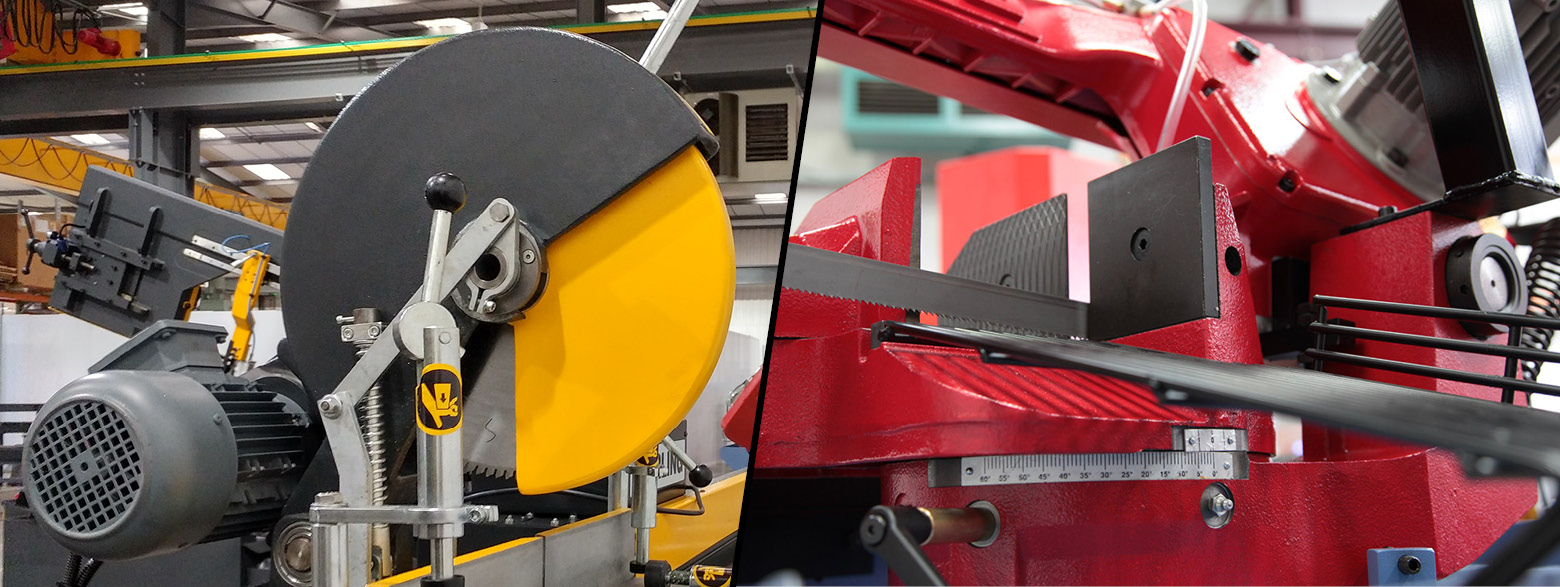
Dialing In the Bandsaw for a Perfect Cut
Getting clean results from a bandsaw starts before you touch the material. Make sure the blade guides are properly adjusted and the tension is set according to the blade width. On a vertical bandsaw, fine-tune the blade position so it tracks true — even a slight drift will throw off your cut. Take a test pass on scrap material whenever you switch blade types or start working with a new metal alloy.
Matching the Saw to Your Project
If the work involves thick bars, long stock, curved profiles, or custom-shaped parts, a bandsaw is typically the smarter pick. The controlled blade action excels on materials that need patience and accuracy. For anyone regularly processing structural steel or round pipe, the bandsaw pays for itself in cut quality and material savings.
On the other hand, if you're mainly cutting sheet metal, light gauge material, or need a tool you can throw in the truck for a field job, the circular saw earns its keep. It's fast, light, and gets the job done when perfect edges aren't the top priority.
Getting More from Your Bandsaw: Guide Kit Essentials
If you've ever wondered how experienced operators get dead-straight cuts every time, the secret often lies in the blade guide setup. Eccentric posts are a small but critical part of the system — they allow micro-adjustments that keep the blade running true under load. Knowing what they do, how to name them, and when to replace them can make a noticeable difference in your results. It's one of those upgrades that quietly improves everything about how your bandsaw performs.