
Table Tennis Robots — The Summary at First Glance
The "table tennis robots" topic started with a thorough test report on table tennis ball machines, which demanded significant effort, but also brought real value to our readers. In order to provide a complete overview, we also created a brand-specific test report covering TT robots. Today's blog compares the most common ping pong table tennis robots you can find. This also includes the TT Buddy series.
Our concrete recommendation for price-conscious players: the Paddle Palace A32W Pro Robot — reliable, affordable, and easy to maintain on a budget. All in all, robots are something that every player should try, at least once.
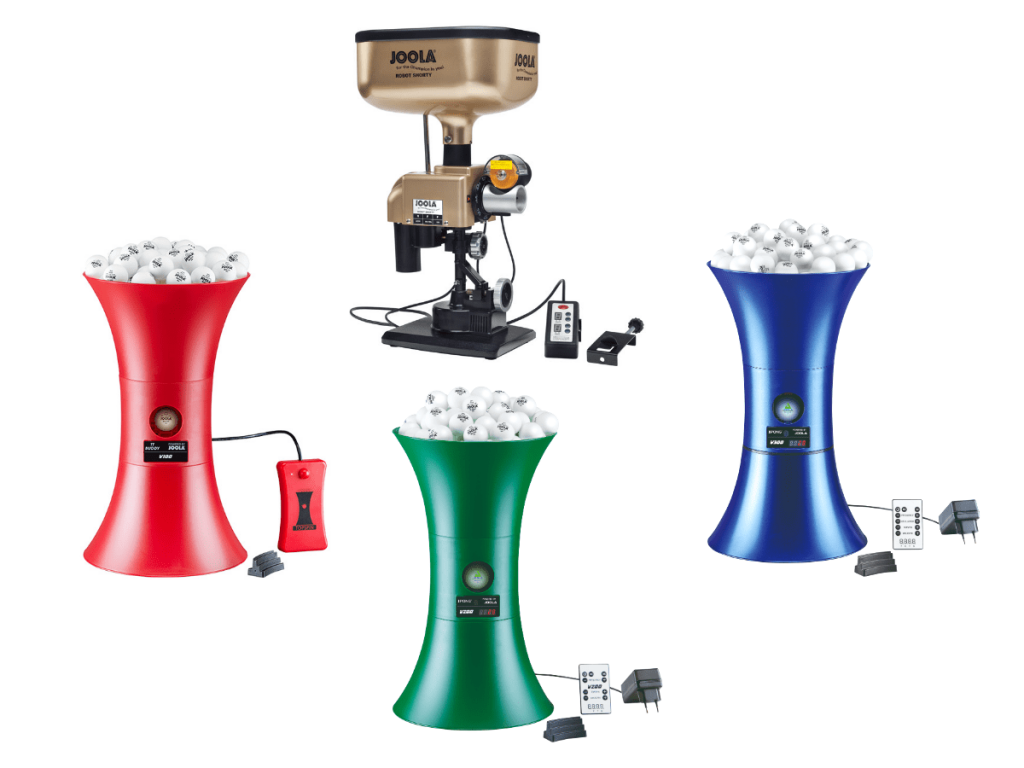
All Table Tennis Robots at a Glance
Before diving into comparisons, here is a quick overview of all tested models ranked by our assessment. The table covers price, oscillation, ball capacity, and rating type.
| Rank | Model | Price | Oscillation | Capacity | Rating | Type |
|---|---|---|---|---|---|---|
| #1 | Shorty | $$$ | •• | ••• | ••• | Beginner+ |
| #2 | V300 | $$$$ | ••• | •••• | •••• | Club |
| #3 | Buddy V200 | $$$ | •• | ••• | ••• | Recreational |
| #4 | Buddy V100 | $$ | • | •• | •• | Entry |
Table Tennis Robots — What Are the Pros and Cons?
Table tennis robots offer a wide range of benefits but also come with certain limitations. The most important thing is that you can never fully replace a human training partner. However, what a robot lacks in natural variation and real-game spontaneity, it more than makes up for in consistency and availability — it is always pre-programmed, never tires, and you do not have to wait for a partner to play with you.
On the other hand, robots from the affordable segment are not capable of generating much spin variety on their own. TT robots also have clear advantages: the automation makes it possible to train very specifically, often in ways that are simply too demanding for human training partners. It is natural to feel right training alone with a robot — great for beginners, improvers, and hobbyists alike.
✦ Advantages
- Available at any time — no partner required
- Consistent ball delivery every session
- Pre-set drills for targeted stroke training
- Great for improving technique at your own pace
- Suitable for all ages and skill levels
Limitations
- Cannot fully replace a human opponent
- Affordable models have limited spin variation
- Spin delivery can be inconsistent at low price points
- May feel repetitive without varied drill programming
Test Results — Our Rankings Compared
We tested four key models extensively. Our criteria included the direct comparison between beginner and club-level play, ball capacity, adjustability, and overall value for money. Below, we walk you through each robot ranked from best to most budget-friendly.
Shorty — Our Top Pick

The first and top position goes to the Shorty. Compared to all other tested robots, this model is the most feature-rich. It scores impressively across all tested categories including the quality of the selected spinning fields and the broader placement options. The trajectory options are plentiful — players can choose between direct and indirect balls, and there is a full-foot function available.
Much of what has been covered can also be controlled remotely using a remote control. The ball capacity is a solid 150, which is adequate for most training sessions. Overall the Shorty is a quality TT ball robot suited for both beginners and advanced players alike.
TT Buddy V300

The second-place finish goes to the TT Buddy V300. This model ranked highest among the TT Buddy lineup and is the primary candidate for comparisons with club players. The ball ejection frequency range is broad — from 40 to 110 balls per minute — and it includes oscillation across multiple directions and full net coverage. The speed of the ejected balls is also adjustable.
There are also positive aspects worth noting. The TT Buddy V300 has an oscillation function and includes a remote control for its settings. The ball capacity sits at 100 balls, making it an excellent option for regular recreational use, club play, and even some professional players.
TT Buddy V200

The third position is taken by the TT Buddy V200. It connects well with our testing criteria for recreational use, is fairly easy to assemble, and you can get started fairly quickly. However, like the V100, the ball ejection frequency is fixed and not adjustable — this is a consideration for players who want full control over their practice sessions.
The positive angle here is that the TT Buddy V200 has its speed set very similarly to the V300 model — so there is no major compromise in that area. Additionally, the speed of the balls and the placement of the ejected balls are adjustable. All in all, the V200 has a clear right to exist in the lineup and is a worthy option for recreational players and beginners.
TT Buddy V100 — Most Affordable

The fourth and final place goes to the TT Buddy V100. This is the most entry-level model in the Joola-oriented lineup. Now, unlike the V200, the V100 does not provide an oscillation setting — which is a notable trade-off at this price. However, the ball ejection frequency is still adjustable and the ball feed setting is available.
The TT Buddy V100 is the most suitable for hobby and recreational circles — it is like a quality entry-level robot: easy to handle, perfectly functional, and without unnecessary extras. At its price range, you won't find better value if your goals are light training or introducing a child or beginner to the sport.
Our Recommendation: Paddle Palace A32W Pro Robot
After reviewing all four models in this test, we have made our concrete recommendation for price-conscious players: the Paddle Palace A32W Pro Robot. It brings together strong quality, reliable performance, and good value. Assembly is straightforward, you can maintain it easily over time, and it will serve as a dependable training partner for a very long time.
It is important to clean these machines from time to time, as with all other things — general maintenance keeps the balls in top condition and keeps the machine running well. Make sure to also check on the other robots periodically and confirm their functionality when you bring them out of storage.
Final Tips for Getting the Most from Your TT Robot
- Clean the ball collector and feed mechanism regularly to ensure consistent delivery.
- Start sessions with lower ball frequency and increase as your reaction time improves.
- Vary the placement settings each session to train footwork as well as stroke technique.
- Use spin settings deliberately — don't rush into topspin and backspin drills until fundamentals are solid.
- Store your robot properly between sessions and check for ball wear before each training block.
Final Verdict
All models we reviewed are reliable and worth exploring, regardless of skill level. Every robot has its own right to exist in the lineup, and finding the right one simply depends on your goals, budget, and how seriously you take your training. Whether you are picking up a paddle for the first time or sharpening competitive strokes, a table tennis robot is a genuine training upgrade.
For those looking for the best balance of performance and price, our recommendation stays clear: