
Meet the Steel Full-Sus 29er
There is something stubbornly appealing about a steel frame on a full-suspension mountain bike. Most manufacturers fled the material decades ago in favor of aluminum and carbon, yet a small cluster of builders kept the faith — convinced that the right steel, tubed correctly and paired with thoughtful suspension design, could produce a trail bike unlike anything made from shinier stuff. This is a bike born from that conviction.

Our long-term test unit arrived in a colorway that looks like a Pacific Northwest forest floor in autumn — muted, earthy, honest. Exactly what you would expect from a manufacturer with strong opinions about what a trail bike should feel like and a clear disregard for visual spectacle for its own sake. It is a beautiful machine, in the way that well-worn tools are beautiful.
Frame & Material
The frame is built from triple-butted steel tubing — a detail worth dwelling on, because not all steel is created equal. Butting removes material from the low-stress mid-sections of each tube while thickening the walls at the weld zones, where stress concentrates. The result is a frame that is meaningfully lighter than its gauge would suggest, while retaining the compliance and durability that make steel worth choosing in the first place.
Every tube junction is TIG-welded by hand. You can see the care in the beads — consistent, tight, unhurried. The rear triangle is notably short and tight, keeping the wheel close to the rider and contributing to the bike's surprisingly snappy behavior on tight switchbacks. The frame finish is a matte clearcoat over bare steel, which will develop a character all its own if you ever let it get wet, which you absolutely will.
Geometry & Sizing: Long, Low, Slack
The geometry chart tells a clear story. A 66-degree head tube angle plants this bike firmly in modern trail territory — slack enough to feel composed on steep, loose descents without becoming the kind of bike that punishes you for attempting anything technical on the way up. The reach is generous, the stack is moderate, and the bottom bracket sits low enough to inspire confidence in corners without scraping pedals on everything in sight.
The bike runs a 150mm fork up front paired with 130mm of rear travel — a combination that splits the difference between an enduro sled and a XC whippet. It is built to go everywhere at a reasonable pace rather than to dominate any single discipline. Riders who have spent time on older, shorter, higher machines will feel an immediate shift in where their weight sits and how the front wheel tracks. It takes one descent to understand. It takes a full season to fully internalize.

"One descent to understand, a full season to truly internalize — that is what modern geometry feels like when it's executed without compromise."
Going Up
Steel full-suspension bikes have a reputation for being heavy climbers. That reputation is not entirely undeserved — physics and material density are difficult to argue with — yet this bike manages the ascent better than its spec sheet suggests it should. The suspension platform remains firm without being locked out, bobbing only under the most abrupt pedal strokes. Seated climbing on moderate grades feels efficient and smooth, with the rear end tracking rough terrain rather than deflecting off it.
Out of the saddle on steeper pitches, the frame's compliance becomes most apparent. On an aluminum or carbon bike, trail chatter under hard efforts transmits directly into your hands and feet. On this bike it is absorbed — not entirely, but enough to preserve grip and reduce fatigue on long climbs. You arrive at the top more ready to ride down than you have any right to be.

Interlude: How the Suspension Works
The linkage-driven rear suspension on this bike follows a four-bar design with a progressively rising rate. What that means in practice is a suspension that plushes out early in the stroke to absorb small, repetitive hits — roots, pebbles, the constant low-amplitude noise of a trail — while stiffening up as it approaches full compression to resist bottoming on big impacts.
The anti-squat values are tuned to fall close to 100% in the middle of the cassette, which is where most riders spend most of their climbing time. The result is a rear end that climbs without wasting energy in bobbing, but that does not sacrifice small-bump sensitivity in the process. It is a balance that took considerable engineering to achieve, and it is the primary reason this bike rides so differently from simpler single-pivot designs in the same travel category.
Going Down
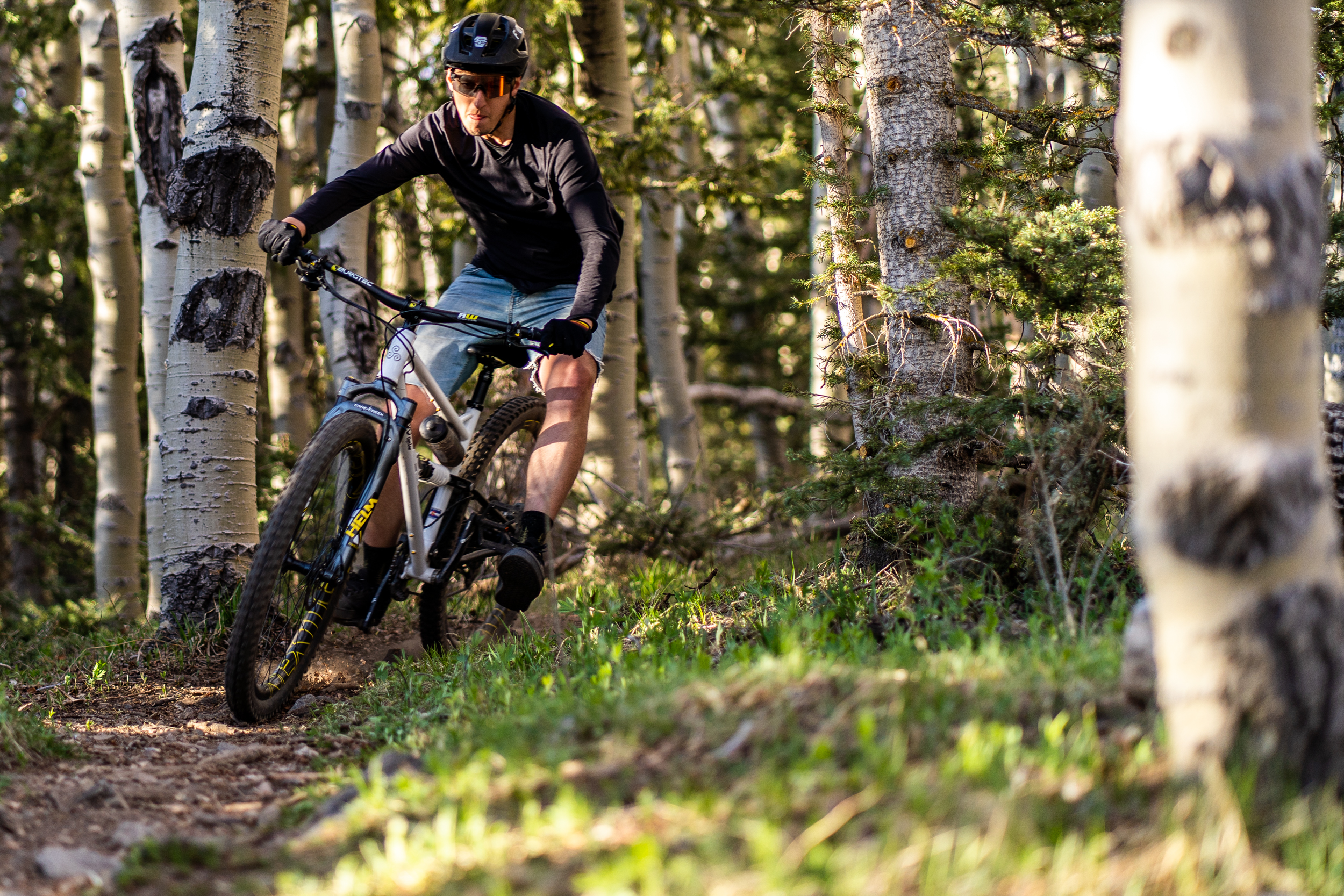
This is where the bike earns its keep. Drop the saddle, weight the outside pedal, and point it at something that ought to be frightening — the bike remains conspicuously calm. The 29-inch wheels roll over trail debris that stops smaller-wheeled bikes dead, and the chassis compliance absorbs the impacts that do register with a smoothness that carbon simply cannot replicate at this price point.
Traction is remarkable. On loose-over-hard terrain — the kind that sends front wheels skittering and inspires terror in lesser bikes — this machine finds grip where there apparently is none. Part of that is the wheel size, part is the geometry, and part is something harder to quantify: a combination of steel's flex characteristics and suspension sensitivity that keeps tires in contact with the ground through direction changes, not just in straight lines.
High-speed stability is outstanding. The bike tracks straight through chatter without requiring constant correction, letting you look further ahead and plan earlier. Cornering is confidence-inspiring rather than merely adequate. You push harder than you planned to, and the bike rewards you for it. After a full season, the magic has not worn off.
The Long-Term Verdict
After a full season of hard use — big days, bad weather, technical terrain, and the sort of regular abuse that exposes weak points in any bicycle — this steel full-suspension 29er has not revealed a single reason to question the choice of material or design. Welds remain pristine. Bearings are tight. The paint has scratches in exactly the right places. The bike has aged the way good tools age: with honesty and without apology.
It is not the lightest bike in its travel category, nor the stiffest, nor the most aerodynamic. It is, however, the most consistently enjoyable bike we have ridden for long mountain days at any pace. For riders who have spent time chasing marginal performance gains and want to come back to something that simply feels good to ride, this is the answer.
Longer in reach. Higher in travel. Calmer in temperament. This is what a mature, well-considered trail bike looks like in steel.