

When it comes to selecting the ideal sewer inspection camera, the marketplace offers plenty of options — which is great news. The challenge, however, is that numerous variables must be weighed carefully to ensure the camera you choose truly fits your operational demands. Below, we have outlined the essential questions every buyer should evaluate before committing to a pipeline inspection camera. Throughout each consideration, always factor in the diameter and accessibility of the pipes you will be surveying.
High-Definition: Understanding Resolution
One of the earliest choices you will face is determining your camera's resolution requirements. Traditional CCTV cameras relied on analog signals that produced standard definition footage. But what exactly does resolution mean? In simple terms, resolution describes the total number of pixels that make up an image. Each pixel is an incredibly small dot — invisible to the naked eye on its own — but when millions of them come together, they form the detailed picture you see on screen. More pixels translates to a more detailed, crisper image and therefore higher resolution.
Standard definition (SD) encompasses any resolution at or below 480p in pixel height. High definition (HD), by contrast, starts at 720p and above. When you hear "Full HD," that refers specifically to 1080p resolution, which translates to 1920 pixels wide by 1080 pixels tall (1920×1080). Multiply those figures together and a single Full HD frame contains over two million individual pixels. Whether someone says 1080p, Full HD, or 1920×1080, they are all describing the same thing.
The principle is straightforward: higher resolution means sharper, more lifelike footage. That clarity is precisely what makes HD video so valuable for underground inspections. However, bear in mind that increased resolution also demands greater bandwidth and storage capacity for transferring and archiving your recordings.
Achieving high-definition output requires a digital control system. A Controller Area Network (CAN) bus serves as a high-integrity serial communication system designed for networking intelligent devices. CAN bus technology is widely used across automotive and industrial applications. Originally developed by Bosch in 1985 for vehicle networking, CAN replaced the cumbersome point-to-point wiring that had become increasingly heavy and expensive as vehicles incorporated more electronic components. By switching to in-vehicle network architecture, manufacturers drastically reduced wiring complexity, cost, and weight. The automotive world rapidly embraced CAN, and by 1993 it earned its place as the international standard under ISO 11898.
Key Advantages of CAN Technology:
✓ Instantaneous response for camera and tractor commands, with the ability to manage multiple controls at the same time
✓ Programmable autonomous functions that save valuable time, including auto-drive to waypoints and auto-retrieve
✓ Built-in alert capabilities such as graphical roll-angle displays for rollover risk, seal integrity monitoring, internal pressure tracking, and temperature and humidity sensors
Note: Analog components are increasingly difficult to source as manufacturers shift focus toward digital systems. Choosing a digital platform now helps future-proof your investment.
Zoom Capability
How far can the pipeline inspection camera you are evaluating zoom in, and how much magnification do you actually need? The optimal zoom range will depend largely on your working conditions. In smaller diameter sewer pipes, the confined space naturally limits how far you can see. Irregularities in the pipe — bends, sags, and offsets — restrict how much light you can project ahead, which in turn reduces the effectiveness of maximum zoom.
On the other hand, larger storm drains and trunk lines give you significantly more viewing distance, especially when supplemented with auxiliary lighting. In those environments, you will want and be able to take full advantage of extended zoom capabilities, so be sure to factor that into your camera selection.
Lighting
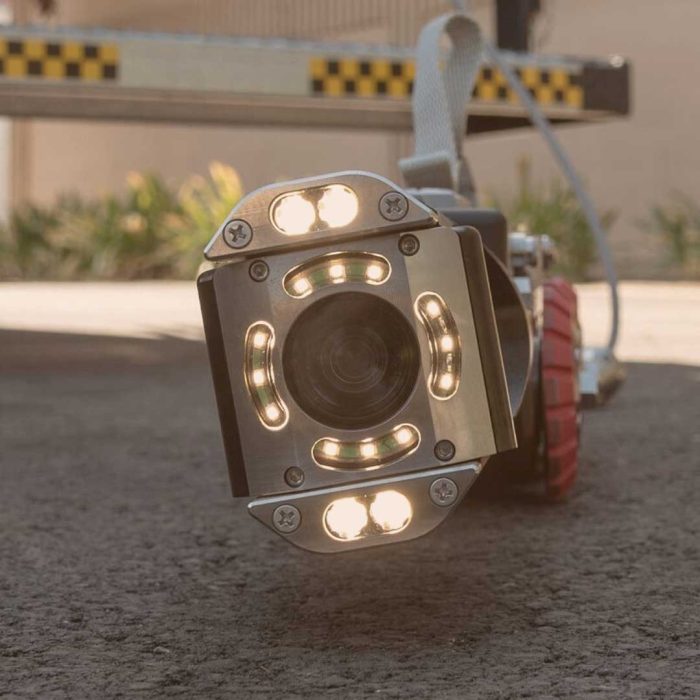
Does the inspection camera feature LED illumination? LEDs are the gold standard for underground work because they deliver brighter output, last far longer than traditional bulbs, and generate minimal heat — so there is no risk of burning them out during extended inspections. Many LED-equipped cameras also include built-in trip circuits for added protection.
Sewer Camera Pressurization
Moisture and electronics are natural enemies, and sewer inspection cameras face constant exposure to wet environments, high humidity, and nighttime condensation. That is why it is critical to verify whether the camera is pressurized — and ideally with nitrogen rather than compressed air. Nitrogen is a dry gas that maintains positive pressure inside the housing, keeping internal components dry. This protection becomes especially valuable if the camera is accidentally submerged, minimizing the risk of water damage to sensitive electronics.
Advanced inspection cameras come equipped with a regulator and an external nitrogen canister specifically designed to pressurize the unit. Onboard diagnostics let you monitor nitrogen levels in real time, and the regulator automatically shuts off when necessary to prevent over-pressurization.
Pro Tip: Always check camera pressure as part of your daily startup routine. Maintain a log book to track pressurization trends over time. If you notice that you are needing to re-pressurize more frequently — say weekly instead of monthly — it could be an early sign that a seal or O-ring needs replacement.
Adaptability
If you are upgrading or replacing a sewer inspection camera, backward compatibility with your existing fleet of inspection tractors can be a significant advantage. Look for cameras that offer adapter options so the new unit can pair seamlessly with your older tractor models, protecting the investment you have already made in your equipment lineup.
In-the-Pipe Lens Cleaning
Sewer inspections frequently run in tandem with pipe cleaning operations. When the camera follows behind a jetting nozzle, splashes can leave water marks on the lens and obscure your view. Grease is another common culprit — if it coats the camera, it leaves a persistent sheen that prevents you from getting a clear picture of the pipe wall.
Cameras equipped with in-pipe lens cleaning technology eliminate the need to retrieve the unit every time the lens gets dirty. This is a massive time-saver. Without this feature, a debris-covered lens means pulling the camera out, hosing it off, reinserting it, and hoping you do not encounter the same obstruction again — resulting in repeated stoppages and lost productivity.
How does it work? The lens pans, tilts, and rotates a full 360 degrees. A blade mounted on the backside of the camera frame acts as a wiper — when the lens completes its rotation, it skims across the blade to scrape off debris automatically.

This self-cleaning technology means you can carry on inspecting without interruption. Navigate through pipe bellies clogged with grease or debris, activate the lens wiper, and continue your survey. Jobs get completed faster and you gain far greater flexibility when working in lines that are not perfectly clean.
Durability & Field Repairability
For anyone working in the harsh conditions found underground, equipment durability is non-negotiable. Equally important is the ability to make repairs in the field to keep your crew productive. Before purchasing, evaluate the quality of materials in the camera's construction and determine how easily components can be accessed and replaced on-site. For instance, cameras with user-replaceable wiper blades allow operators to swap parts right at the job site, minimizing downtime and saving money.
Access to Service & Parts
Any inspection equipment purchase should involve partnering with a reputable manufacturer that offers accessible, high-quality service centers and easy access to replacement parts. Look for brands that provide comprehensive support programs where most equipment issues can be resolved through expert phone assistance. When hands-on repair is needed, service should be available through authorized centers and vetted dealer networks. As a best practice, prioritize manufacturers who can quickly ship replacement parts and offer loaner programs to keep your operations running at full capacity while repairs are completed.
Asking the right questions while shopping for a sewer inspection camera is the surest path to getting the best possible equipment for the job at hand. Invest the time upfront, and your crew will thank you for it every day in the field.