
Every sailing club has a collection of boat launch dollies tucked away somewhere, and each one tells a story of resourcefulness. Some have endured years of salt, sun, and sand while others barely survived a season. Curious about what makes certain designs outlast the rest, one boater set out to study the homemade launch carts at the local club — pulling a few neglected ones from corners and marveling at the ingenuity behind each build.
After a personal Skerry dolly gave out — the handle was not reinforced enough and the support bent under the hull — it became clear that understanding different dolly construction methods was essential. Here is what was discovered.
Plastic Pipe Dinghy Dolly
Among the most common designs at the club were dollies built from black plastic pipe. They are lightweight and inexpensive, but many had cracked at the joints where the glue gave way. Typically constructed from 3-inch diameter pipe, these frames are adequate for lighter dinghies but lack the rigidity needed for anything heavier.
Black pipe tends to be somewhat brittle and not stiff enough for larger boats. It also flexes under load, which raises the craft uncomfortably high off the ground. Additionally, the wheels on these models are usually secured with cotter pins through a wood or metal axle — simple but not always reliable.
On a closer look, the wheel hubs were fastened to an aluminium crossbar using U-clamps, with plenty of washers layered in to prevent the plastic from rubbing against the metal. The wheel assembly was still holding strong, but several of the pipe sections had snapped. For a full-sized dinghy, plastic pipe just does not cut it.
Wooden Cart on a Welded Pipe Frame
This particular dolly was a charming mix of old-school craftsmanship and brute strength. The wheel — roughly 12 inches across — was fashioned from soft, knot-free wood, and it rolled beautifully. No fancy oak or hardwood, just common lumber cut into a circle and attached to a welded pipe frame.
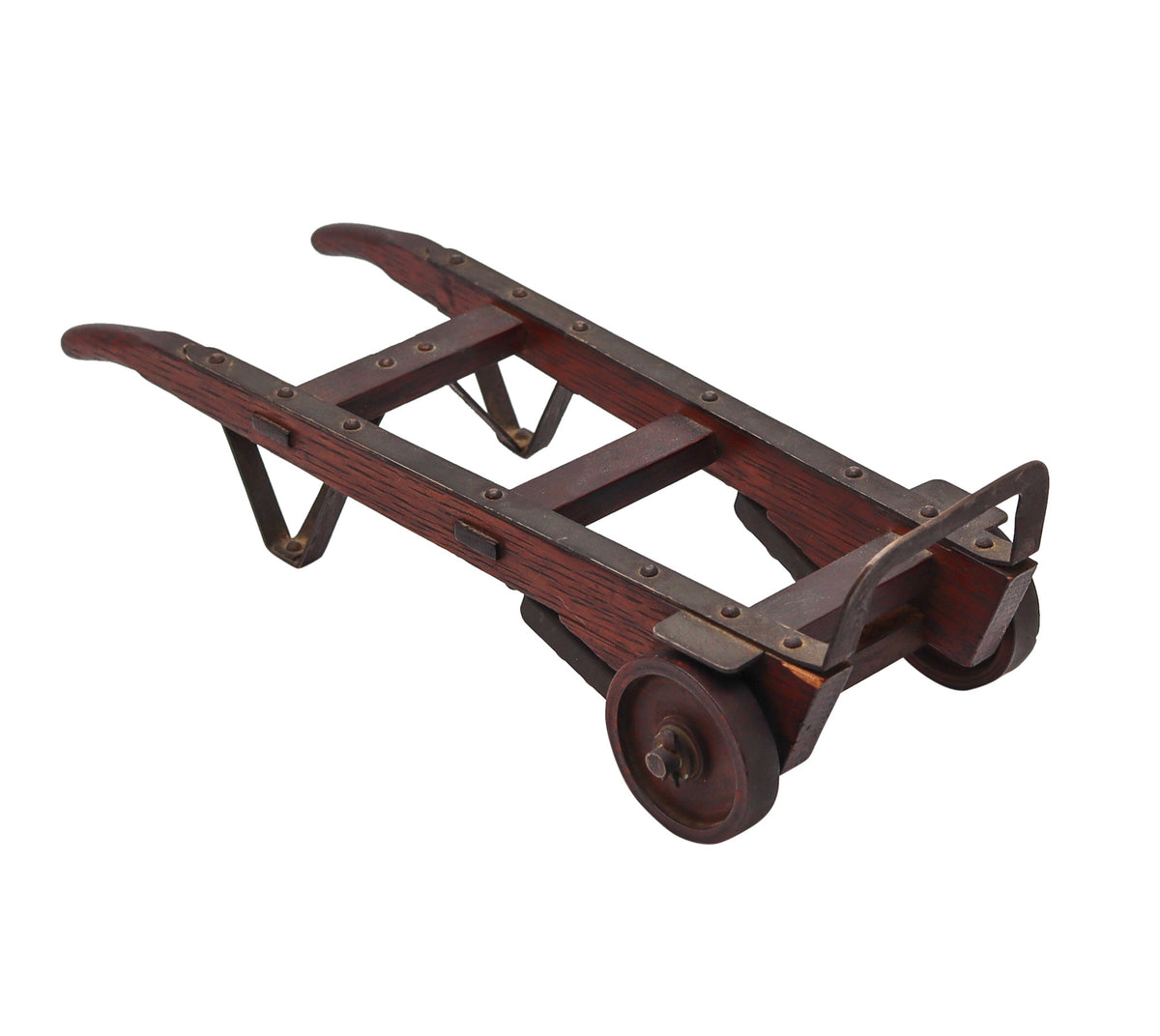
The axle was nothing more than a piece of rebar drilled through the wheel center and pinned with a cotter. A square plywood plate sat in the middle of the frame to cradle the hull. The whole assembly used a couple of 2x6 lumber pieces running in opposite directions, joined with Robertson screws. Its simplicity and retro charm were genuinely delightful — proof that effective does not have to mean complicated.
One downside: it would not float particularly high, which rules out easy water-edge launching. Floating dollies, while nice in theory, tend to make retrieving the boat from the water more of a chore than a convenience.
Aluminium Pipe & Fiberglass Box Trolley
A neat little tender launch trolley, this one was built around a fiberglass box with aluminium pipes slotted through holes in its sides. Steel pipe ran through the lower section to hold the wheels in place. One of the aluminium support braces had snapped and been replaced with a length of green rope — not exactly elegant, but still functional.
The result was a slightly wobbly dolly that nonetheless continued to serve its purpose. It goes to show that a well-conceived core design can survive a lot of wear and improvised repairs.
Angle Iron Launching Trollies
Two dinghy dollies at the club were both assembled from angle iron, each with a distinct approach. The first was bolted together without any welding, making it easy to disassemble for storage or transport. The second was welded into a rigid triangular configuration, offering more stability but less portability.
Nearby sat another dolly welded from square steel pipe. It was compact and solid — the kind of build you would expect from someone comfortable with a welder and not overly concerned about weight.
Heavy-Duty Welded Steel Dolly
The steel dollies in the club's fleet were undeniably the toughest of the bunch. Fitted with large, rugged wheels, these carts were built to handle serious abuse — and they did, day after day, serving the school boats without complaint. Their length was adjustable thanks to a long square iron pipe that could slide forward or back, and the whole frame could be shortened for trailering inside the boat.
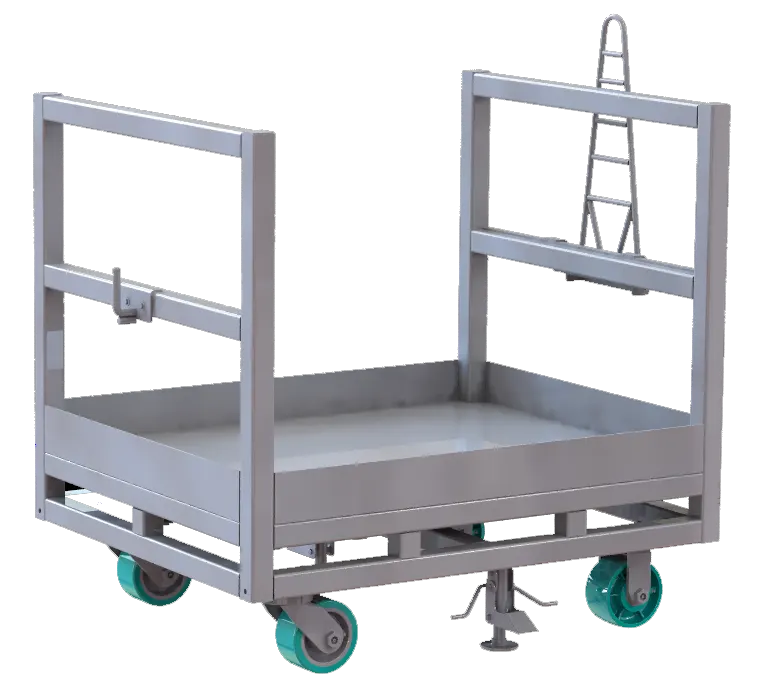
Because the steel version comes apart easily, stowing it aboard during a sail is no issue at all. This was ultimately the style chosen for a Skerry build — sturdy, adjustable, and practical. If welding equipment were available, this would be the go-to method for building a new dolly from scratch.
The Personal Build: A Dolly That Delivers
After evaluating every design at the club, the final build came together using old iron pipe and an aluminium tube, with all joints reinforced using carbon fiber and strong adhesive. The result? A dolly for a small Apple Pie Tender that has been performing flawlessly.
After two full years of regular use, the carbon fiber joints are holding perfectly. The only sign of aging is some minor rust forming on the wheel. Nothing about this design needs changing — it is simple, strong, and reliable. It has been in use for a couple of years now and continues to hold up remarkably well.
Looking for a Professional-Grade Dolly Solution?
Skip the DIY hassle and get a dolly built to last — engineered for strength, portability, and daily use.
Sumner ST-401 Grasshopper Pipe DollyWhether you choose to weld your own steel frame, glue together a pipe-and-fiber solution, or invest in a ready-made commercial dolly, the key is matching the build to your boat's weight and your launching conditions. A good launch dolly saves your back, protects your hull, and makes every trip to the water a pleasure instead of a chore.
Happy launching from the Backyard Provider team.