
If you've ever browsed foosball tables online, you've probably noticed that some are described as having "solid" rods while others feature "telescopic" rods. It might seem like a small detail, but the type of rod on your table can significantly affect your playing experience, the safety of those around it, and how long the table lasts.
Below, we walk you through everything you need to know about both rod styles — from how they're built to how they perform — so you can make the best decision for your home, game room, or outdoor setup.
In This Article
What Are Solid Rods? · What Are Telescopic Rods? · Safety Considerations · Performance & Durability
What Are Solid Rods?
Solid rods are exactly what the name suggests — single, unbroken bars of steel or chrome that run straight through the cabinet of the foosball table. The player figurines are permanently fixed along the rod, and one end is fitted with a comfortable grip or handle for control. The opposite end of the rod extends out from the other side of the table.
Because they are one continuous piece of metal, solid rods are inherently sturdy and rigid. There's no flex, no give, and no moving parts within the rod itself. This straightforward design is what makes them the go-to choice for professional and tournament-grade tables, where precision is everything.
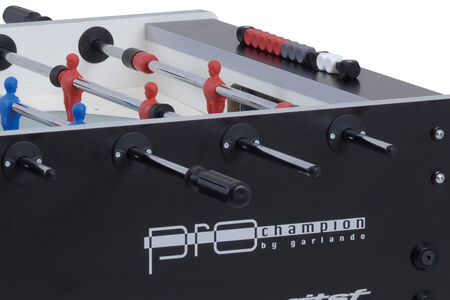
Solid rods on a professional-grade foosball table — notice how the rod extends through both sides.
What Are Telescopic Rods?
Telescopic rods have a more intricate two-part construction. Each rod consists of an inner core and an outer sleeve. The sleeve — which is the thicker section fitted with the player's handle — slides over the core much like a collapsible antenna. When you push or pull the rod, the sleeve glides along the inner bar, allowing the rod to retract into itself rather than protruding out the opposite side of the table.
This clever mechanism means that at no point does any part of the rod stick out beyond the edges of the cabinet. It's a design born out of practicality and safety — and it's become increasingly popular for home foosball tables and family-friendly setups.
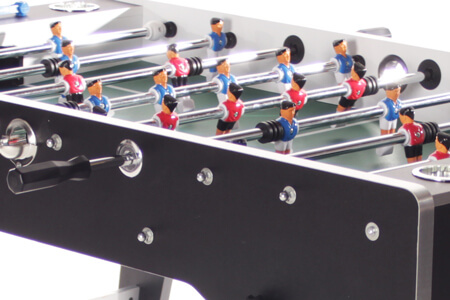
Telescopic rods retract smoothly into the table, keeping both sides of the cabinet clear.
Safety First: Why It Matters More Than You Think
The telescopic rod was originally engineered as a direct response to safety concerns. As foosball tables moved from arcades and pubs into family homes, manufacturers recognized a potential hazard — especially for younger players and children.
With solid rods, the far end of the bar pushes outward from the table whenever a player moves it. During an active game, this isn't usually a major concern because players on both sides are engaged and aware. However, when the table is sitting idle, those protruding rods can pose a real risk. Foosball table rods typically sit at roughly the same height as a small child's face, and a quick bump or a playful push can lead to an unfortunate accident.
Telescopic rods remove this hazard entirely. Because the rod folds into itself, there's never a metal bar poking out from the side of the table — whether the game is in play or not. If your table will be in a space where children are present, telescopic rods offer meaningful peace of mind.
✦ Quick Safety Takeaway
If your foosball table will live in a family room, a children's play area, or any high-traffic zone, telescopic rods are the safer choice. For dedicated game rooms used primarily by adults, solid rods are perfectly fine.
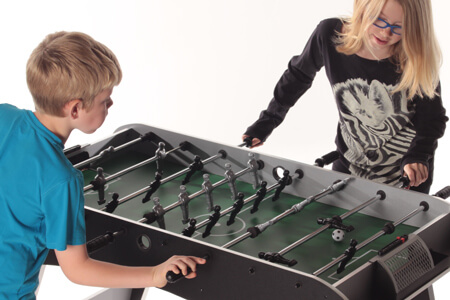
Kids enjoying a game on a family-friendly foosball table equipped with telescopic rods.
Performance & Durability
Ask any seasoned foosball enthusiast and they'll almost certainly tell you that solid rods deliver a superior level of control. Because the rod is one rigid piece of metal, every twist and push translates directly to the player figurines with zero play or wobble. This precision is exactly why competitive and tournament-level tables are nearly always fitted with solid rods.
Durability is another strong point for solid rods. Being a single tubular bar with no sliding components, there's simply less that can wear out or break over time. If longevity and heavy use are priorities — say, for a game room that sees regular action — solid rods tend to age more gracefully.
That said, modern telescopic rods have come a long way. High-quality models offer smooth, responsive sliding action that satisfies all but the most competitive players. For casual play, family fun, and recreational use, you'd be hard-pressed to notice a meaningful difference.
Solid Rods
✦ Superior precision & control
✦ More durable over time
✦ Tournament-grade standard
✦ Best for competitive play
Telescopic Rods
✦ Safer for homes with children
✦ No protruding bars
✦ Great for casual & family play
✦ Improved modern designs
Featured Product
Ready to Bring the Competition Home?
Explore our selection of premium foosball tables and find the perfect match for your game room, patio, or backyard setup.
The Bottom Line
Choosing between solid and telescopic rods ultimately comes down to how and where you plan to use your foosball table. If competitive play, maximum control, and long-term durability are your priorities, solid rods are the clear winner. If safety, family-friendly design, and a clean table profile matter more, telescopic rods are the smarter pick.
Either way, the best foosball table is the one that gets played — so pick the rod style that fits your lifestyle and start enjoying the game.