
Everything you need to know about choosing the right electric stacker for your warehouse or facility
An electric stacker represents the perfect middle ground between a manual pallet jack and a full-size forklift. These versatile machines deliver impressive lifting capabilities while maintaining a compact footprint that makes them ideal for tight warehouse spaces and narrow aisles.
Essential components of an electric stacker include a powerful traction motor, hydraulic mast assembly, rechargeable battery pack, electronic controller, and various optional accessories like roll clamps and extended forks. Thanks to advanced lithium battery technology, these machines provide rapid charging and consistent power delivery throughout demanding shifts. Many warehouse managers find that a single stacker with two rotating shifts can maintain continuous operations without any interruption.
Types of Electric Stackers
Electric stackers are manufactured in several distinct configurations, each engineered with specific features and operational capabilities to meet different material handling requirements.
Standard Electric Pallet Stacker
This entry-level configuration features fixed support legs positioned under the forks, providing a straightforward and reliable solution for everyday pallet handling. Engineered specifically for open-bottom pallets, these stackers excel at straight lifting operations up to mid-rack heights.
Electric Straddle Stacker
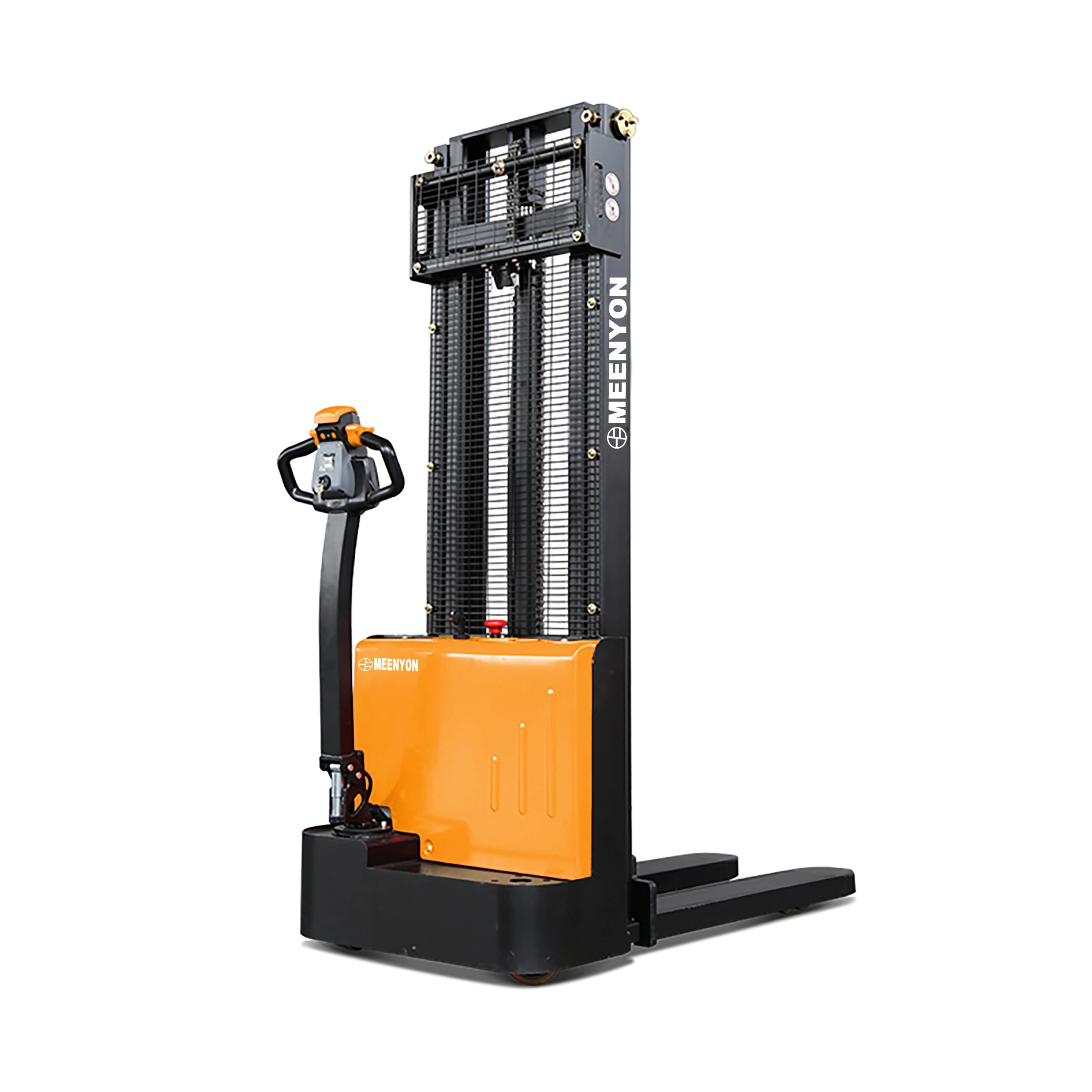
Featuring wider adjustable support legs that straddle the pallet from both sides, this stacker provides enhanced stability and versatility. The reinforced frame and upgraded hydraulic system accommodate heavier loads while still maintaining a pedestrian-friendly footprint. It handles closed-bottom pallets and various pallet sizes with ease.
Ride-On Electric Stacker
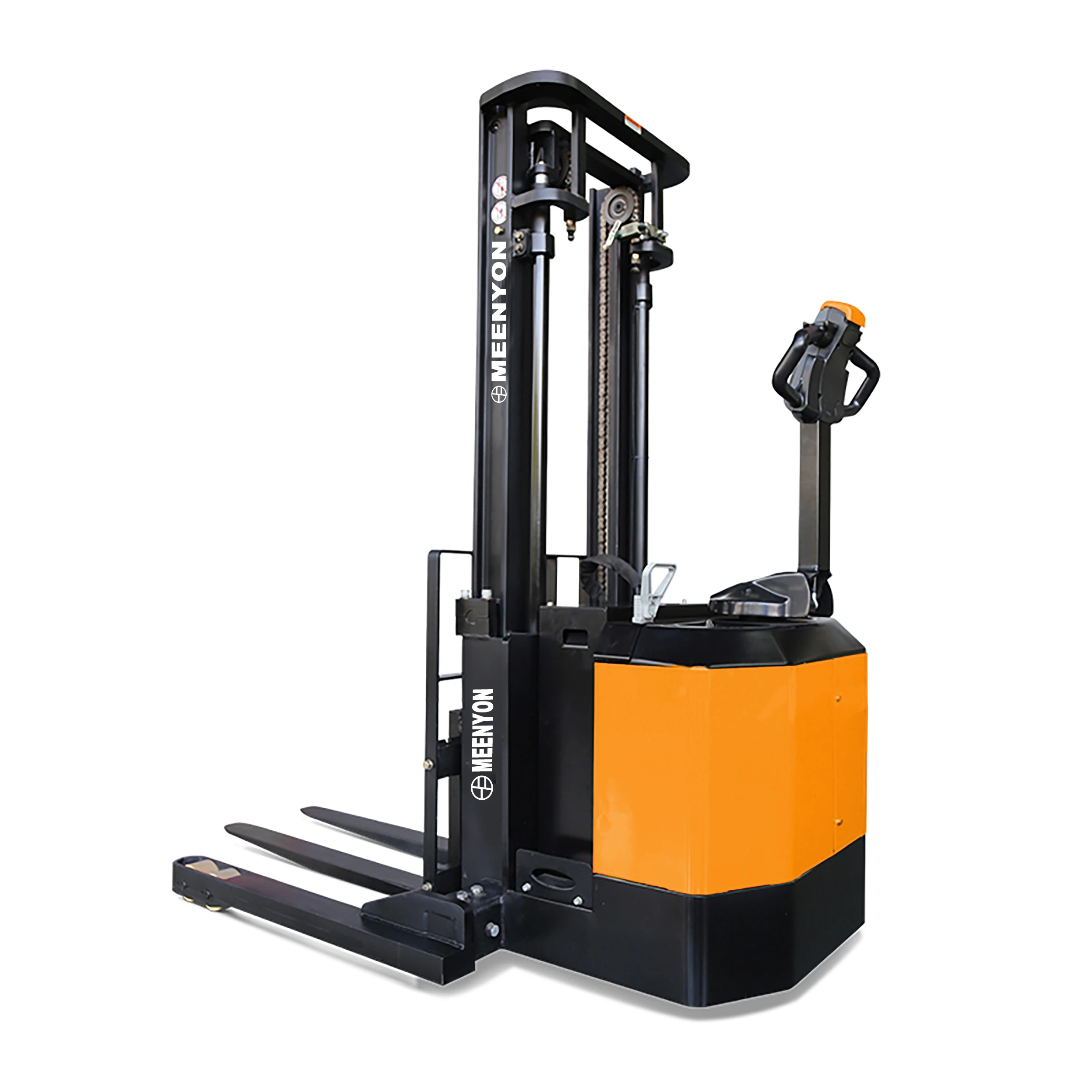
Equipped with either a fold-down or permanently fixed platform plus standing operator controls, this stacker bridges the gap between walk-behind units and conventional forklifts. Enhanced drive motors, integrated safety interlocks, and faster travel speeds make it the preferred choice for larger warehouse operations requiring extended travel distances.
Electric Reach Stacker

This specialized machine incorporates a pantograph mechanism that extends the forks forward, enabling precise positioning within deep racking systems and double-deep storage configurations. Ideal for high-density warehouses where maximizing storage capacity takes priority, it offers superior reach capabilities while navigating confined spaces.
Electric Counterbalance Stacker
Eliminating front support legs entirely, this design relies on rear-mounted counterweights to balance loads. The open front allows direct approach to racks, machinery, and fixtures without obstruction. Despite its heavier construction and extended wheelbase, it maintains a smaller overall footprint compared to traditional forklifts while delivering comparable lifting performance.
What Is the Difference Between a Forklift and a Stacker?
Although both machines lift and transport pallets, electric stackers and forklifts serve distinctly different purposes. Stackers are constructed to be lighter with reduced floor loading requirements, making them suitable for mezzanines, suspended slabs, and areas where forklifts would exceed weight restrictions. Their energy consumption differs significantly as well—modern stackers operate on compact battery packs (typically 24-48V) with integrated charging systems, whereas forklifts depend on larger battery banks or LPG/diesel fuel sources.
Operator visibility and workflow dynamics also vary considerably. Stacker operators work behind or beside a compact platform with clear forward sightlines and intuitive tiller controls, minimizing the learning curve. Forklifts deliver greater lifting heights and heavier load capacities but demand more extensive operator training, licensing requirements, and wider operational clearances. For facilities prioritizing indoor pallet movement at moderate heights, stackers offer a more economical and space-efficient alternative.
Typical Applications & Industries
Retail Backrooms
Regional retail chains utilize standard pallet stackers to replenish shelving inventory from backroom storage during slower business hours.
Food & Pharmaceutical Logistics
Electric straddle stackers efficiently manage mixed pallet configurations in temperature-controlled and refrigerated environments without producing emissions or fumes.
Light Manufacturing
Counterbalance electric stackers position components directly alongside production machinery where conventional straddle legs would interfere with equipment placement.
Third-Party Logistics Hubs
Ride-on electric stackers accelerate cross-dock transfers over extended distances without requiring operators to walk the entire forklift fleet.
These examples demonstrate how a single battery-powered stacker adapts effectively to diverse operational environments and workflow demands.
How to Choose the Right Electric Stacker
Apply these key factors as a starting framework when evaluating different electric stacker models. They assist in matching equipment to your specific workspace requirements, load specifications, and operational goals without prematurely committing to any single configuration.
Looking for a Professional Electric Stacker?
Explore our range of high-quality electric stacker models including standard, straddle, and counterbalance configurations designed for your operation.
Tory Carrier Counterbalanced Stacker 3300 lbsFAQ's about Electric Stackers
Q1. Can an electric stacker be used on ramps or uneven floors?
Light ramps are suitable for rated models, but uneven outdoor surfaces may compromise stability. Always check the manufacturer's floor condition specifications before operating on non-level surfaces.
Q2. What maintenance does an electric stacker forklift need?
Primarily battery care, periodic hydraulic checks, and controller diagnostics. Since there's no engine oil or exhaust components to maintain, electric stackers require significantly less upkeep compared to diesel forklifts.
Q3. How does an electric pallet stacker differ from an electric pallet jack?
An electric pallet jack only transports loads at floor level, whereas an electric pallet stacker includes a mast to lift items into racks or stack them vertically.
Final Words
An electric stacker combines the nimble footprint of a pallet jack with the vertical lifting power of a forklift, making it a versatile, clean, and cost-effective choice for modern warehouses. By understanding the main types, their key components, and where they perform best, procurement managers and supervisors can select a battery-powered stacker that improves throughput without over-investing in heavy equipment.