
The indoor farming sector is experiencing unprecedented growth, driven by increasing demand for locally sourced produce, climate change concerns, and advancements in agricultural technology. At the heart of this agricultural revolution lies a crucial component that determines success or failure: sophisticated HVAC (Heating, Ventilation, and Air Conditioning) systems designed specifically for controlled environment agriculture.
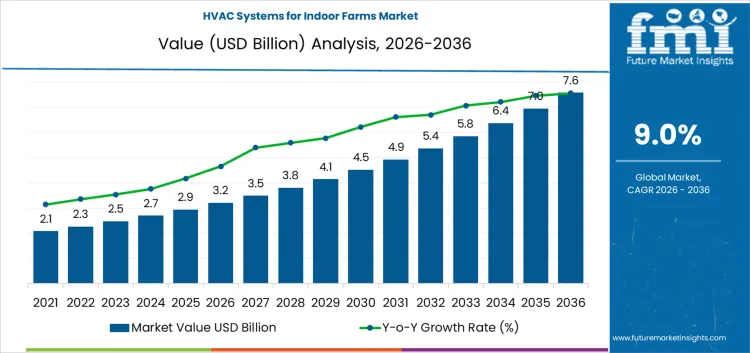
What Forces Are Shaping the Demand for Indoor Farm HVAC Systems?
The global market for HVAC systems tailored to indoor farming operations is projected to witness remarkable expansion through 2036. Several interconnected factors are fueling this growth trajectory, including the escalating need for year-round crop production independent of external weather conditions, the rising popularity of vertical farming in urban environments, and growing consumer preference for pesticide-free produce grown in controlled settings.
Environmental control systems represent the backbone of any successful indoor farming operation. These specialized HVAC installations must maintain precise temperature ranges, typically between 65°F and 80°F depending on crop varieties, while simultaneously managing humidity levels that can fluctuate dramatically based on plant transpiration rates and growth cycles.
Key System Functions in Controlled Environment Agriculture
Modern indoor farm HVAC systems perform multiple critical functions simultaneously. They regulate air temperature across different growing zones, control relative humidity to prevent disease and optimize plant growth, ensure adequate CO2 distribution for photosynthesis, filter airborne pathogens and particulates, and manage airflow patterns to strengthen plant stems while preventing hot spots.
Understanding System Function Types and Their Applications
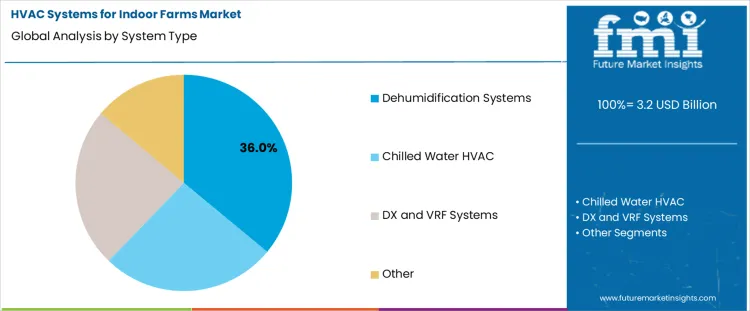
Indoor farming facilities deploy various HVAC system configurations based on their specific operational requirements. Heating systems maintain optimal temperatures during cooler periods and nighttime operations, utilizing technologies ranging from traditional forced-air furnaces to more efficient heat pump solutions and radiant heating systems designed for greenhouse applications.
Cooling systems represent perhaps the most critical component, as indoor grow lights generate substantial heat that must be continuously extracted. Advanced chilled water systems, precision air conditioning units, and evaporative cooling technologies each offer distinct advantages depending on facility size, climate zone, and crop requirements. Ventilation systems work in concert with heating and cooling components to ensure fresh air exchange, CO2 replenishment, and proper air circulation throughout the growing environment.
65-80°F
Optimal Temperature Range
50-70%
Ideal Humidity Levels
800-1200
PPM CO2 Enrichment
Why Crop Consistency Requirements Drive HVAC Investment
Commercial indoor farming operations demand exceptional consistency in crop quality, appearance, and yield. Environmental variations that might seem minor—a few degrees of temperature fluctuation or slight humidity changes—can dramatically impact plant development, harvest timing, and ultimately profitability. This reality drives substantial investment in precision HVAC systems capable of maintaining tight environmental tolerances around the clock.
Advanced Control Systems for Precision Growing
Year-round production models require HVAC systems that can adapt to changing conditions instantaneously. Modern control systems integrate sensors throughout the growing facility to monitor temperature, humidity, CO2 levels, and air quality in real time. These intelligent systems automatically adjust equipment operation to maintain optimal growing conditions while minimizing energy consumption.
The integration of smart technology into indoor farm HVAC systems represents a significant leap forward in operational efficiency. Automated controls can respond to environmental changes faster than any manual adjustment, preventing the temperature and humidity swings that can stress plants and compromise yields. Furthermore, these systems collect valuable data that helps operators optimize growing protocols over time.
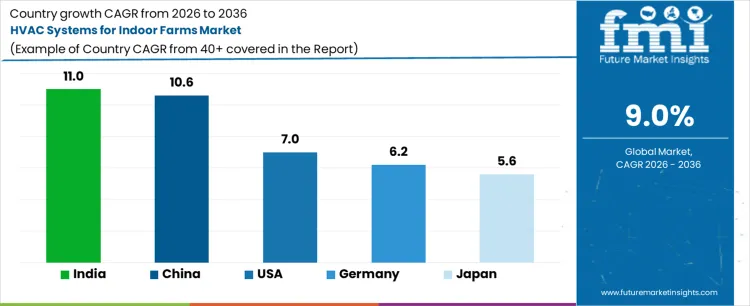
Global Market Dynamics and Regional Demand Patterns
The demand for indoor farm HVAC systems varies significantly across different geographic regions, influenced by climate conditions, agricultural traditions, government policies, and economic factors. North America has emerged as a leading market, driven by substantial venture capital investment in vertical farming startups and growing consumer demand for locally produced greens and vegetables throughout the year.
Key Regional Market Insights
North America: Expected to maintain the highest market share through 2036, fueled by technological innovation and strong investor interest in sustainable agriculture solutions.
Europe: Significant growth anticipated as countries pursue food security initiatives and seek to reduce agricultural imports and associated carbon footprints.
Asia-Pacific: Rapid expansion projected, particularly in Japan, China, and Singapore, where land scarcity and urbanization drive adoption of vertical farming technologies.
Latin America: Emerging market potential as agricultural modernization initiatives gain momentum across the region.
Leading Industry Players and Competitive Landscape
The indoor farm HVAC market features a diverse mix of established HVAC manufacturers expanding into agricultural applications and specialized companies focused exclusively on controlled environment agriculture. Major industry participants are investing heavily in research and development to create more energy-efficient systems, recognizing that electricity costs represent one of the largest operational expenses for indoor farming facilities.
Competition among manufacturers has accelerated innovation across multiple fronts. Companies are developing hybrid systems that combine multiple cooling technologies for improved efficiency, creating modular solutions that can scale with facility expansion, and integrating artificial intelligence capabilities that predict and respond to environmental changes before they impact crop quality.
Energy Efficiency Focus
Leading manufacturers are prioritizing energy-efficient designs, with some systems achieving 30-40% reductions in power consumption compared to conventional HVAC equipment.
Modular System Design
Scalable, modular HVAC solutions allow indoor farms to expand capacity incrementally, reducing initial capital requirements while maintaining environmental consistency.
Market Outlook and Future Growth Projections
Industry analysts project continued robust growth in the indoor farm HVAC market through 2036 and beyond. Several macro trends support this optimistic outlook, including increasing urbanization, growing awareness of food supply chain vulnerabilities exposed during recent global disruptions, and mounting pressure on traditional agriculture from climate change and water scarcity.
The convergence of agricultural technology with advanced HVAC engineering represents a pivotal development in global food production. As indoor farming continues to mature from niche application to mainstream agricultural practice, the systems that control growing environments will play an increasingly vital role in feeding urban populations worldwide.
For growers and facility operators considering indoor farming ventures, selecting the right HVAC system represents one of the most consequential decisions affecting long-term success. The ideal system must balance initial capital costs against operational efficiency, provide sufficient capacity for planned production levels with room for expansion, and integrate seamlessly with other facility systems including lighting, irrigation, and nutrient delivery.